Used Transmissions: A Smart, Cost-Effective Auto Maintenance Guide
A modern vehicle’s transmission is one of its most intricate—and expensive—mechanical components. When a transmission experiences catastrophic failure, vehicle owners face a steep financial hurdle. A brand-new replacement can easily cost several thousand dollars, frequently rivaling or exceeding the total market value of an aging vehicle.
In response to these steep repair bills, many consumers explore purchasing a used transmission (often sourced from a donor or salvage vehicle). Opting for a pre-owned unit can offer an affordable transmission replacement strategy, but a lower upfront part price does not automatically guarantee a lower total cost. Making a smart financial decision requires weighing total installed expenses, compatibility requirements, component conditions, warranty protections, and long-term mechanical risks.
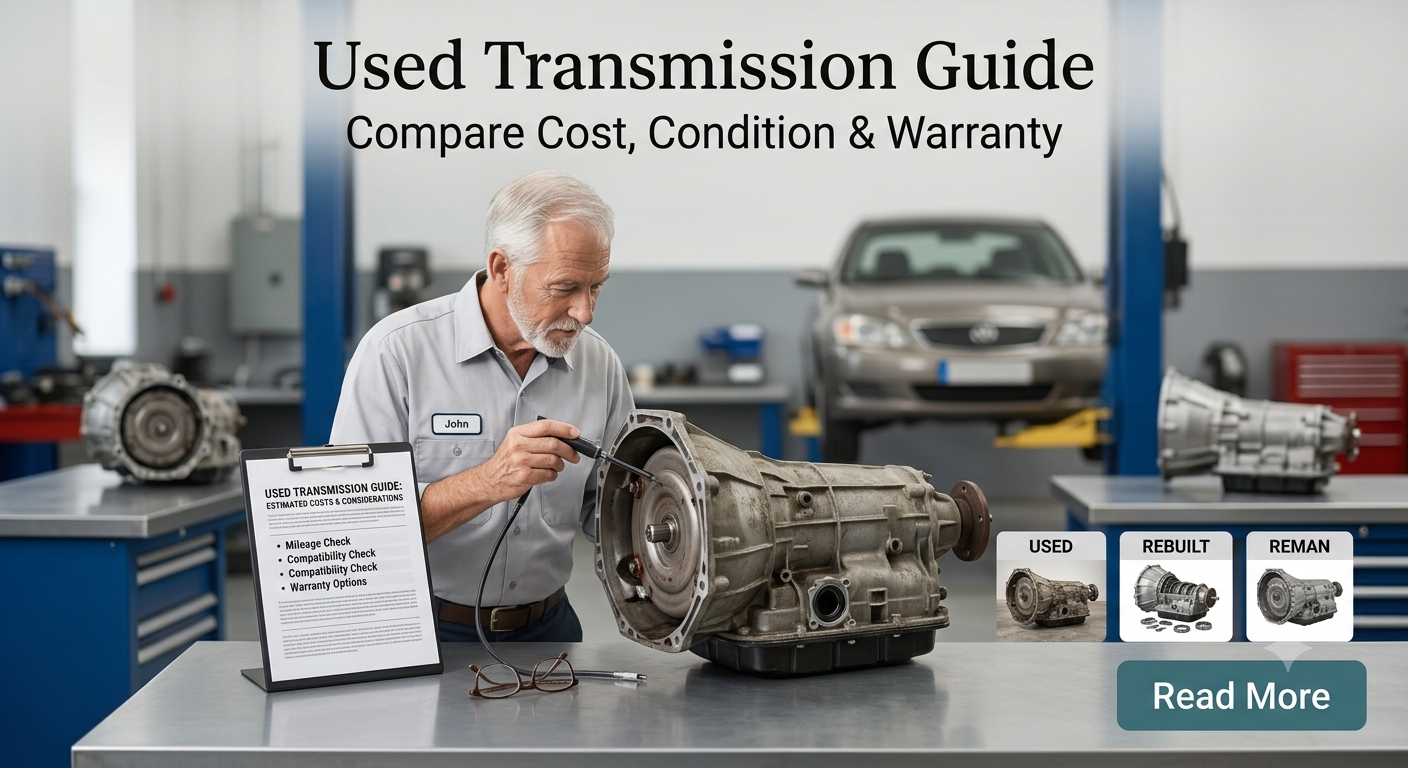
A modern vehicle’s transmission is one of its most intricate—and expensive—mechanical components. When a transmission experiences catastrophic failure, vehicle owners face a steep financial hurdle. A brand-new replacement can easily cost several thousand dollars, frequently rivaling or exceeding the total market value of an aging vehicle.
In response to these steep repair bills, many consumers explore purchasing a used transmission (often sourced from a donor or salvage vehicle). Opting for a pre-owned unit can offer an affordable transmission replacement strategy, but a lower upfront part price does not automatically guarantee a lower total cost. Making a smart financial decision requires weighing total installed expenses, compatibility requirements, component conditions, warranty protections, and long-term mechanical risks.
What Is a Used Transmission?
A used transmission (sometimes called a used gearbox) is an assembly removed from a donor vehicle and sold for reuse without being fully disassembled, overhauled, or remanufactured. These units typically originate from vehicles retired due to collision damage, insurance total-losses, or severe body damage where the drivetrain remains intact.
To make an informed choice, it is essential to distinguish a used unit from other replacement options on the market:
-
Used / Salvage Transmission: Removed from a donor vehicle and resold in its current operational condition. It may undergo basic external inspection, fluid checks, or bench testing, but internal components remain in their original, worn state.
-
Rebuilt Transmission: The original transmission is disassembled by a local technician or specialized shop. Worn or failed components (such as clutches, bands, or seals) are replaced, while functional original parts are cleaned and retained.
-
Remanufactured Transmission: Restored in a factory setting to original equipment manufacturer (OEM) specifications. The unit is completely torn down, all wearable parts are replaced with new ones, core Machining is performed, and software/hardline updates are applied before undergoing dyno testing.
-
New / OEM Transmission: Produced brand-new directly by the vehicle manufacturer or authorized supplier. It contains zero pre-owned components and represents the highest baseline quality (and price point).
How Much Does a Used Transmission Cost?
There is no universal price tag for a used transmission. Part costs vary based on vehicle popularity, age, mechanical complexity, and supply and demand. Current market data indicates that parts-only prices for used transmissions range from several hundred to a few thousand dollars.
The following table outlines indicative market ranges for the part only:
|
Vehicle / Transmission Category |
Indicative Used-Part Range |
|---|---|
|
Economy Vehicle |
$300 – $900 |
|
Midsize Vehicle |
$500 – $1,500 |
|
Truck / SUV |
$800 – $2,000+ |
|
Luxury / Specialty Vehicle |
$1,500 – $4,000+ |
Note: These figures represent indicative market estimates for parts only. Final prices depend heavily on donor mileage, local market rates, and seller testing protocols. Shipping, core charges, shop labor, replacement fluids, and taxes will significantly increase the total installed cost.
What Determines the Price?
Several interconnected variables shape the market price of a pre-owned unit:
-
Make, Model & Model Year: High-volume vehicles benefit from abundant donor supplies, driving prices down. Rare models or short production runs carry premium price tags.
-
Transmission Type: Standard manual transmissions feature fewer moving parts and are generally cheaper than automatic counterparts. Continuously Variable Transmissions (CVTs) and Dual-Clutch Transmissions (DCTs) carry higher price tags due to specialized designs and internal complexities.
-
Mileage & Overall Condition: Lower-mileage units command a premium. A unit harvested from a vehicle with 40,000 miles costs noticeably more than one with 140,000 miles.
-
Testing & Seller Inspection: Transmissions that have undergone fluid testing, compression checks, or spin testing cost more upfront than “as-is” pull-and-pay yard components.
-
Warranty Protection & Core Charges: A unit backed by a 6-month or 1-year parts-and-labor warranty costs more than an “as-is” part with a 30-day exchange window. Sellers may also assess a refundable core charge until your old unit is returned.
-
Freight & Logistics: Heavy auto parts require freight shipping. Long-distance transport fees add directly to the part’s initial acquisition cost.
Used vs. Rebuilt vs. Remanufactured vs. New
Choosing the right replacement requires balancing upfront savings against long-term risk and vehicle retention plans.
|
Option |
Potential Advantage |
Main Risk / Consideration |
|---|---|---|
|
Used |
Lowest initial part cost; ideal for tight budgets or older vehicles. |
Unknown internal wear, history, and potential hidden defects. |
|
Rebuilt |
Worn components replaced; original housing preserved. |
Quality depends entirely on the skill and standards of the local rebuilder. |
|
Remanufactured |
Factory-standardized restoration, updated parts, comprehensive warranties. |
Higher initial purchase price compared to used or rebuilt options. |
|
New / OEM |
Factory-fresh component with zero wear and tear. |
Highest initial cost; often cost-prohibitive for older vehicles. |
The Total Installed Cost
A common pitfall in auto maintenance is evaluating a repair solely on the component’s purchase price. Installation labor often matches or exceeds the part cost.
To calculate your actual financial obligation, use this total cost formula:
$$\text{Total Cost} = \text{Part Price} + \text{Shipping} + \text{Core Charge} + \text{Shop Labor} + \text{Fluids/Filters/Seals} + \text{Programming/ECU Flash}$$
  ┌─────────────────┐     ┌─────────────────┐     ┌─────────────────┐
  │ Transmission    │  +  │ Shipping & Core │  +  │ Labor (6-12 hrs)│
  │ Part Price      │     │ Fees            │     │ & Diagnostics   │
  └────────┬────────┘     └────────┬────────┘     └────────┬────────┘
           │                       │                       │
           └───────────────────────┼───────────────────────┘
                                   │
                                   ▼
  ┌─────────────────┐     ┌─────────────────┐     ┌─────────────────┐
  │ Fluids, Filters │  +  │ ECU Programming │  =  │ ESTIMATED TOTAL │
  │ & Axle Seals    │     │ & Flash Fees    │     │ INSTALLED COST  │
  └─────────────────┘     └─────────────────┘     └─────────────────┘
Professional transmission installation typically takes between 6 and 12 hours of labor. At shop labor rates ranging from $100 to $200+ per hour, labor costs alone routinely fall between $600 and $2,000+.
If a low-cost $500 used transmission fails two weeks after installation, you must pay for a second labor fee to pull the defective unit and install another replacement. This makes part-only savings vanish instantly. Always request an itemized, written estimate from your technician detailing labor, fluid fees, diagnostic time, and seal replacements prior to ordering parts.
How to Verify Compatibility
Visual inspection alone is never sufficient to verify transmission fitment. Modern vehicles rely heavily on electronically controlled gearboxes with specific sensor configurations, gear ratios, and torque tolerances.
Before placing an order, cross-reference these critical specifications:
-
Vehicle Identification Number (VIN): Reputable auto recyclers use VIN-decoding software to match donor components to your exact vehicle trim and build specs.
-
Transmission Identification Code: Stamped directly onto the transmission case, this alphanumeric code identifies the exact internal engineering revision.
-
Drivetrain & Engine Match: Confirm whether your vehicle is Front-Wheel Drive (FWD), Rear-Wheel Drive (RWD), All-Wheel Drive (AWD), or Four-Wheel Drive (4WD). Match engine displacement (e.g., 2.0L vs 2.5L) precisely.
-
Gear Ratios & Differential Units: Installing a unit with an incorrect final drive ratio will trigger diagnostic trouble codes (DTCs), cause limp-mode operation, or damage transfer cases in AWD systems.
-
Electrical Connectors & Harnesses: Wiring harness pins, solenoid counts, and internal sensor configurations frequently change midway through a model year production run.
Questions to Ask Before Buying a Used Transmission
Protect yourself against unvetted parts by using this buyer checklist when speaking with salvage yards, auto recyclers, or online brokers:
-
[ ] Donor Vehicle: What specific vehicle year, make, and model did this unit come from?
-
[ ] Mileage: What was the verified odometer reading of the donor vehicle?
-
[ ] Removal Reason: Why was the donor vehicle decommissioned (e.g., rear-end collision vs. mechanical scrap)?
-
[ ] Testing Procedures: Has this unit undergone fluid checks, bench testing, or road testing? Is documentation available?
-
[ ] Warranty Scope: What is the duration of the warranty, and does it cover labor costs in addition to part replacement?
-
[ ] Core & Returns: Is there a core charge, and what is the exact return policy if the unit proves incompatible?
-
[ ] Torque Converter: Is a tested torque converter included with automatic models?
-
[ ] Programming: Does this transmission require dealer-level ECU or TCU reflash/reprogramming after installation?
-
[ ] VIN Verification: Can the seller guarantee fitment using your vehicle’s 17-digit VIN?
Warranty Matters
A written warranty converts an uncertain purchase into a managed mechanical risk. When evaluating used transmission cost options, prioritizing warranty quality over minor price differences is paramount.
Pay close attention to these warranty factors:
-
Parts-Only vs. Parts-and-Labor: Most standard salvage warranties are parts-only—if the unit fails, the seller provides a replacement transmission, but you must pay the shop for the labor to swap it. Premium extended warranties may offer partial labor coverage.
-
Installation Requirements: Many warranties require proof that new fluid was installed, a new filter was fitted, and the transmission cooler lines were flushed prior to operation. Failing to keep shop receipts for these steps can void coverage.
-
Authorized Repairs: Warranties strictly dictate who can perform repair or diagnostic work. Unauthorized disassembly will instantly invalidate your contract.
Warning Signs When Buying Used
Avoid transactions with sellers or suppliers displaying these red flags:
-
Refusal or inability to verify fitment using your VIN.
-
No mileage records or vague answers regarding donor vehicle history.
-
Absence of a written warranty or clear return/exchange terms.
-
Missing serial numbers or scrubbed transmission identification tags.
-
Pressure tactics forcing an immediate sale with “as-is, no-refund” conditions.
-
Prices far below regional market averages, indicating an uninspected or damaged unit.
When a Used Transmission May Make Sense
Choosing a pre-owned gearbox is often a practical, budget-conscious choice under the right circumstances:
-
Older Vehicles: The car has significant mileage or lower overall market value, making a $4,000+ remanufactured unit financially unwise.
-
Abundant, Popular Models: Common platforms yield high volumes of low-mileage donor parts at competitive prices.
-
Documented Donor Quality: The unit comes from a verified low-mileage donor vehicle with complete maintenance logs and testing reports.
-
Short-to-Medium Ownership Goals: You plan to drive the vehicle for another 1 to 3 years rather than a decade.
When a Used Transmission May Not Be the Best Choice
In certain scenarios, investing in a remanufactured or rebuilt unit offers superior long-term value:
-
Labor-Intensive Vehicles: If replacing the transmission requires pulling the entire subframe or engine block (resulting in $1,500+ in labor alone), installing an unvetted used unit carries too much labor-risk.
-
Known Failure-Prone Designs: Certain CVT models or early-generation automatics have high factory defect rates; buying a used unit simply inherits another ticking time bomb.
-
Long-Term Vehicle Retention: You plan to keep the car for many years and require max reliability backed by a multi-year, nationwide parts-and-labor warranty.
How to Protect Your Investment After Installation
Once your replacement transmission is installed, taking proactive care steps ensures smooth performance and protects warranty coverage:
-
Use Exact OEM-Specified Fluids: Never use generic “universal” fluids unless explicitly approved by the manufacturer. Modern transmissions depend on precise friction coefficients provided by specific fluid formulas.
-
Flush Cooler Lines: Ensure your installer flushes the transmission fluid cooler and lines to prevent metal shavings from the old, failed unit from contaminating the replacement gearbox.
-
Replace Seals and Filters: Always install new input shaft seals, axle seals, pan gaskets, and fluid filters during the swap.
-
Execute Software Adaptations: Have the shop clear existing transmission adaptation tables or perform ECU re-learning procedures so the car adjusts its shift timing to the replacement unit.
-
Maintain Documentation: Store your purchase invoice, installation work order, fluid purchase receipts, and warranty contract together in your vehicle records.
Frequently Asked Questions
Is buying a used transmission worth it?
Yes, provided the vehicle’s market value, the donor unit’s mileage, and total installation costs are aligned. It is often the most cost-effective solution for aging cars.
How much does a used transmission cost?
Part-only prices typically range from $300 to $2,500+ depending on the vehicle’s make, model, year, and transmission type. Installed prices generally run between $1,400 and $4,000+.
Is a used transmission cheaper than a rebuilt one?
The upfront part price of a used unit is almost always cheaper than a shop rebuild. However, if a used unit fails prematurely and requires duplicate labor, a rebuilt unit with a solid warranty may prove more cost-effective long-term.
How do I know if a used transmission will fit my car?
Verify compatibility using your vehicle’s 17-digit VIN, exact transmission identification code, drivetrain configuration, and engine displacement with a reputable supplier.
How many miles is too many for a used transmission?
Ideally, search for units with under 80,000 miles. For high-mileage donor units (over 100,000 miles), ensure the price is substantially discounted and backed by testing or warranty coverage.
Should I buy a used transmission from a salvage yard?
Buying from a reputable auto recycler or vetted salvage network is fine, provided they offer VIN-matching, fluid/bench testing, clear return policies, and a written warranty.
Does a used transmission come with a warranty?
Most reputable sellers offer standard warranties ranging from 30 days up to 1 year, with some offering optional extended parts-and-labor coverage. Always obtain warranty terms in writing.
Does installation cost more than the transmission itself?
In many cases, yes. Complex installations requiring 8 to 12+ hours of labor can result in shop labor costs that exceed the purchase price of a $500–$1,000 used part.
Is a remanufactured transmission better than a used one?
A remanufactured unit offers superior reliability and longer warranty coverage because worn parts are completely replaced. However, it comes at a significantly higher upfront price.
What questions should I ask before buying a used transmission?
Ask for the donor vehicle’s mileage, removal reason, testing documentation, exact VIN compatibility, warranty details, return policies, and core return terms.