Understanding Management of Postmenopausal Osteoporosis
Postmenopausal osteoporosis is a progressive skeletal condition characterized by reduced bone mass, diminished structural integrity, and an increased risk of fractures. Often termed a “silent condition,” bone loss typically occurs gradually without obvious symptoms or pain until a bone breaks.
Understanding postmenopausal osteoporosis management involves exploring how bone health shifts following menopause, how fracture risk is evaluated, and how modern medical care combines non-pharmacological habits with targeted prescription therapies to preserve bone strength.
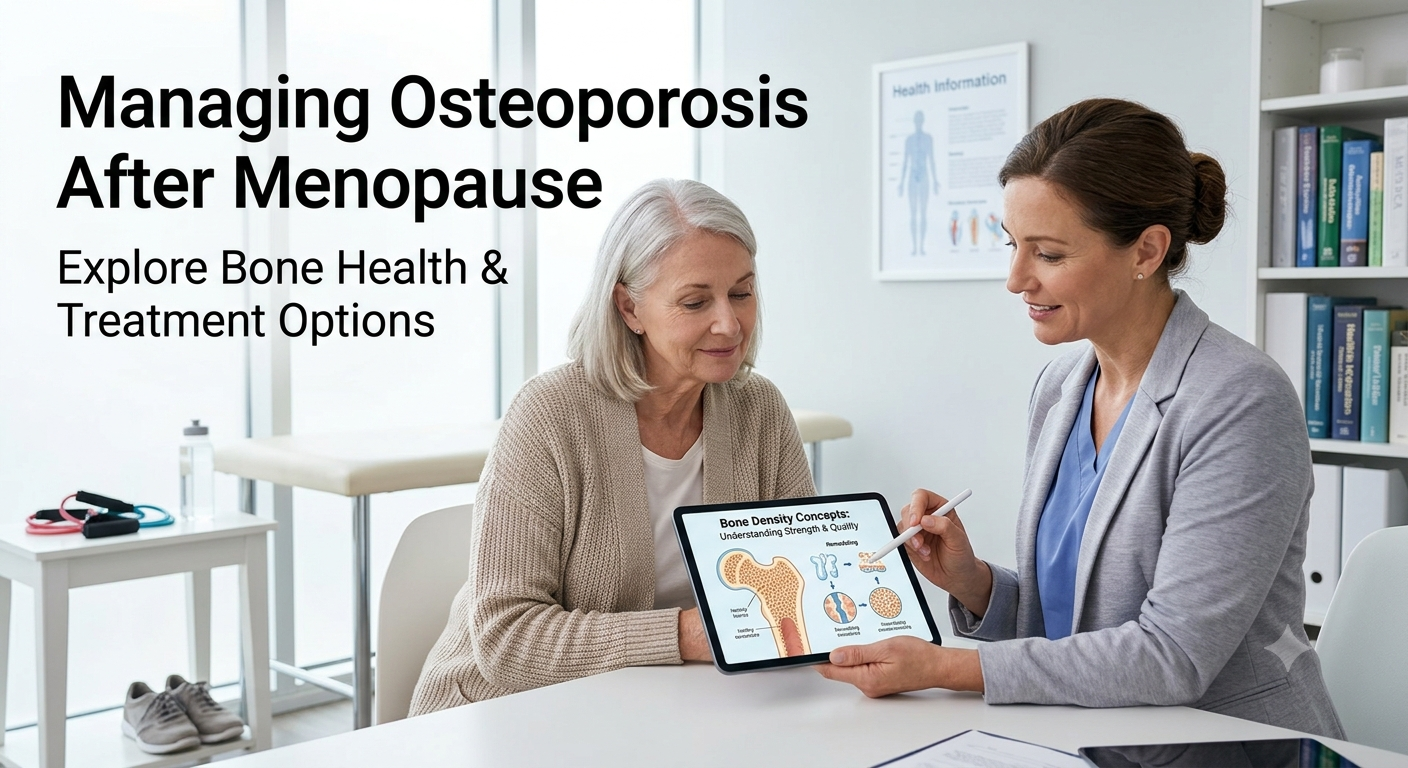
Why Bone Loss Can Increase After Menopause
Bone is a dynamic living tissue that continuously undergoes remodeling—a balance between the breakdown of older bone (resorption) and the formation of new bone.
Estrogen plays a critical regulatory role in this process by suppressing excessive bone breakdown. During the menopausal transition, declining estrogen levels disrupt this balance. Bone breakdown begins to outpace new bone formation, leading to a net loss of bone density.
While bone loss accelerates most rapidly during the initial years following menopause, the elevated risk of skeletal fragility can persist lifelong if unmanaged.
How Osteoporosis Risk Is Assessed
Evaluating bone health after menopause extends beyond measuring bone density alone. Healthcare professionals conduct comprehensive evaluations that integrate multiple diagnostic tools:
-
Medical & Family History: Evaluating prior low-trauma fractures (fractures occurring from a fall from standing height or less), early menopause, family history of hip fractures, and chronic conditions like rheumatoid arthritis.
-
Lifestyle & Medication Review: Identifying long-term use of medications that alter bone turnover (such as systemic glucocorticoids) as well as nutritional and physical activity habits.
-
Risk Calculation Tools (e.g., FRAX): Algorithms that combine clinical risk factors with bone mineral density scores to estimate an individual’s 10-year probability of suffering a major osteoporotic fracture or hip fracture.
Bone Density Testing and Fracture Risk
Dual-energy X-ray Absorptiometry (DXA or DEXA) is the standard non-invasive test used to measure bone mineral density (BMD) at critical sites such as the lumbar spine and hip.
Results are typically reported as a T-score, which compares a patient’s bone density to that of a healthy young adult reference population:
-
Normal: T-score of -1.0 or higher.
-
Osteopenia (Low Bone Mass): T-score between -1.0 and -2.5.
-
Osteoporosis: T-score of -2.5 or lower, or the presence of a fragility fracture regardless of T-score.
Note: Osteopenia indicates reduced bone mass, but it is not a direct guarantee that a person will develop osteoporosis. Rather, it serves as a clinical benchmark to initiate tailored preventative strategies.
Lifestyle Measures for Bone Health
Non-pharmacological strategies form the foundation of long-term management and osteoporosis prevention. While lifestyle adjustments alone may not fully reverse established osteoporosis, they support structural stability and overall wellness.
[Lifestyle Foundations]
   ├── Weight-Bearing Activity (Walking, Stair Climbing)
   ├── Muscle-Strengthening (Resistance Training, Weights)
   ├── Adequate Nutrition (Targeted Calcium & Vitamin D)
   └── Risk Reduction (Smoking Cessation, Alcohol Moderation)
Physical Activity
Engaging in regular physical activity stimulates bone modeling and strengthens supporting musculature:
-
Weight-Bearing Exercises: Activities where bones support body weight against gravity (e.g., brisk walking, low-impact aerobics, stair climbing) help maintain bone density.
-
Muscle-Strengthening Exercises: Resistance training using light weights, resistance bands, or bodyweight exercises helps build muscle strength and joint stability.
Nutritional Support
-
Calcium: Essential for structural maintenance. Dietary sources—such as dairy products, fortified plant milks, canned fish with bones, and leafy greens—are preferred. High-dose supplementation should be guided by a physician to avoid excess intake.
-
Vitamin D: Helps the body absorb calcium effectively. Obtained through safe sunlight exposure, dietary sources, or physician-recommended supplements.
Lifestyle Habits
Avoiding tobacco use and limiting excessive alcohol intake are critical, as both smoking and heavy alcohol consumption negatively impact bone cell function and accelerate bone loss.
Prescription Treatment Options
When fracture risk is high or osteoporosis is confirmed, healthcare providers may recommend osteoporosis medications. Prescription therapies are categorized by how they interact with the bone remodeling cycle:
1. Antiresorptive Agents (Slowing Bone Breakdown)
-
Bisphosphonates: Common first-line treatments (available in oral or intravenous forms) that slow the rate of bone resorption to preserve existing mass.
-
Denosumab: A targeted injection administered every six months that inhibits bone-resorbing cells. Continuous adherence is vital with denosumab, as stopping treatment without a follow-up agent can cause a rapid rebound in bone loss.
-
Selective Estrogen Receptor Modulators (SERMs) & Hormone Therapy: Options like raloxifene mimic estrogen’s protective effects on bone, while hormone replacement therapy (HRT) may be considered for postmenopausal individuals also managing menopausal symptoms.
2. Anabolic Agents (Building New Bone)
-
Parathyroid Hormone Analogues (e.g., Teriparatide, Abaloparatide): Daily injections that actively stimulate new bone formation, typically reserved for individuals at very high risk of fracture.
-
Dual-Action Agents (e.g., Romosozumab): Monthly injections that simultaneously increase bone formation and decrease bone resorption for a limited duration.
Medication selection is highly individualized, taking into account kidney function, prior fracture history, potential side effects, and overall medical history.
Managing Postmenopausal Osteoporosis: A Comparison
|
Management Approach |
General Purpose |
What May Be Considered |
Important Considerations |
|---|---|---|---|
|
Lifestyle & Exercise |
Maintain bone density, balance, and muscle strength. |
Brisk walking, resistance bands, posture/balance work. |
Should be tailored to avoid high-impact spine flexion or fall risks. |
|
Calcium & Vitamin D |
Provide essential nutrients for bone matrix maintenance. |
Dietary adjustments, targeted dietary supplements. |
Supplements support bone health but cannot treat established osteoporosis alone. |
|
Fall Prevention |
Reduce the likelihood of low-trauma accidents. |
Home safety checks, vision updates, balance training. |
Crucial because most osteoporotic fractures result from falls. |
|
Bisphosphonates |
Slow down active bone loss. |
Oral pills (weekly/monthly) or annual IV infusions. |
Requires strict administration rules for oral forms; periodic re-evaluation needed. |
|
Denosumab |
Inhibit bone-resorbing osteoclast cells. |
Subcutaneous injection every 6 months. |
Requires strict timing adherence; stopping requires a transition plan. |
|
Anabolic / Bone-Forming |
Actively build new bone mass. |
Injections used for limited durations (1–2 years). |
Typically followed by an antiresorptive agent to maintain gains. |
Preventing Falls and Fractures
Because most fractures stem from minor falls, fall prevention is a pillar of comprehensive osteoporosis care:
-
Home Safety Adjustments: Secure loose rug edges, improve hallway lighting, install bathroom grab bars, and clear pathways of tripping hazards.
-
Physical Function: Engage in balance training (e.g., Tai Chi) and work with physical therapists to improve gait stability.
-
Personal Health Factors: Schedule regular vision exams and review medications with a pharmacist or doctor to check for drugs causing dizziness or drowsiness.
If you experience sudden, severe back pain, a loss of height, or an injury following a fall, seek prompt medical evaluation to check for potential spinal or extremity fractures.
Monitoring Treatment and Bone Health
Osteoporosis treatment options are rarely static. Management requires ongoing follow-up with a healthcare team:
-
Follow-Up DXA Scans: Typically repeated every 1 to 3 years to assess bone mineral density stability or improvement.
-
Medication Reviews & “Treatment Holidays”: For certain therapies like bisphosphonates, doctors may evaluate whether a patient can temporarily pause treatment after several years while monitoring bone density.
-
Adherence: Taking medications exactly as prescribed is critical to achieving maximum fracture protection.
Questions to Ask a Healthcare Professional
-
What is my current T-score, and what does it mean for my fracture risk?
-
Do my clinical risk factors warrant initiating prescription treatment?
-
What are the benefits, potential side effects, and administration requirements of the recommended medication?
-
How much daily calcium and vitamin D should I aim for based on my diet?
-
Are there specific exercises I should include or high-risk movements I should avoid?
-
When should we schedule a follow-up DXA scan to monitor my progress?
FAQ
What is the best treatment for postmenopausal osteoporosis?
There is no single “best” treatment for everyone. The optimal approach depends on an individual’s fracture risk level, bone density scores, kidney health, prior treatment history, and personal preferences, decided in consultation with a physician.
Can osteoporosis after menopause be reversed?
While completely restoring bone density to youthful levels is generally not possible, modern medications can significantly increase bone density, slow further bone loss, and substantially reduce fracture risk.
What exercises support bone health?
A combination of weight-bearing exercises (brisk walking, low-impact aerobics) and muscle-strengthening exercises (light weightlifting, resistance training) provides the best skeletal benefits.
How is osteoporosis diagnosed?
Osteoporosis is diagnosed using a DXA scan measuring bone mineral density (a T-score of -2.5 or lower), or by the clinical occurrence of a low-trauma fragility fracture.
When is osteoporosis medication recommended?
Prescription treatment is generally recommended for postmenopausal individuals who have experienced an osteoporotic fracture, have a T-score of -2.5 or lower, or meet specific high-risk thresholds on fracture risk calculators like FRAX.
What role do calcium and vitamin D play?
Calcium acts as a building block for bone tissue, while vitamin D enables efficient calcium absorption. While crucial foundations of bone health, nutritional supplements alone are insufficient to treat established osteoporosis without medical management.
How can falls and fractures be prevented?
Combining environmental modifications (removing home hazards, installing grab bars) with balance training, regular eye exams, safe footwear, and muscle-strengthening exercises greatly minimizes fall risks.
How often should bone density be monitored?
Monitoring schedules vary, but follow-up DXA scans are commonly recommended every 1 to 3 years after starting treatment to evaluate progress and guide ongoing care decisions.
Conclusion
Effective postmenopausal osteoporosis management is a comprehensive, long-term journey. By combining targeted non-pharmacological habits—such as strength training, balanced nutrition, and fall prevention—with evidence-based medical therapies, postmenopausal individuals can proactively preserve bone strength and maintain an active, independent lifestyle. Speak with a qualified healthcare provider to develop a personalized bone care plan tailored to your health profile.