Learn More About Inflammation and Eczema
If you or a loved one live with dry, itchy, or irritated skin, you have likely heard that inflammation plays a central role. But what does the connection between inflammation and eczema actually mean for daily skin health?
Understanding how immune activity, environmental factors, and the skin barrier interact can help demystify flare-ups. Below is a guide to how eczema inflammation works, why symptoms vary so widely, and how healthcare professionals approach management.
What Is Eczema?
Eczema is a non-contagious, inflammatory skin condition that affects millions of adults and children worldwide. While “eczema” is an umbrella term for several skin conditions, the most common type is atopic dermatitis.
Atopic dermatitis is characterized by dry, sensitive skin prone to recurring flare-ups. Rather than being a superficial skin issue, eczema is a complex condition involving immune system signaling, structural changes in the skin, and environmental interactions.
What Is Inflammation?
Inflammation is a natural, protective response by the body’s immune system. When the body detects a perceived threat—such as an injury, an infection, or an environmental irritant—it releases chemical signals to mobilize immune cells to the affected area.
-
Acute Inflammation: A short-term, helpful response (such as redness around a minor paper cut) that resolves once healing occurs.
-
Chronic or Disrupted Inflammation: A persistent or overactive response where immune signaling remains active longer than necessary, contributing to continuous tissue irritation.
In atopic dermatitis inflammation, the immune system reacts overly strongly to mild environmental exposures or internal signals, leading to persistent skin discomfort.
How Inflammation Can Contribute to Eczema Symptoms
When exploring what causes eczema inflammation, scientists look closely at how immune cells interact with skin tissue. In people with eczema, the immune system becomes hyper-reactive, releasing inflammatory proteins (cytokines) into the skin layers.
This immune activity directly contributes to common eczema symptoms:
Primary Symptoms                         Secondary Changes
  • Intense itching (pruritus)            • Skin thickening or leatheriness (lichenification)
  • Redness, flushing, or discoloration   • Swelling or raised patches
  • Dryness, flaking, or scaling          • Rawness or weeping from repeated scratching
The relationship between itching and inflammation creates a cycle often called the “itch-scratch cycle.” Itching leads to scratching, which further damages skin cells. Damaged cells release additional inflammatory signals, which in turn intensifies the itch.
The Role of the Skin Barrier
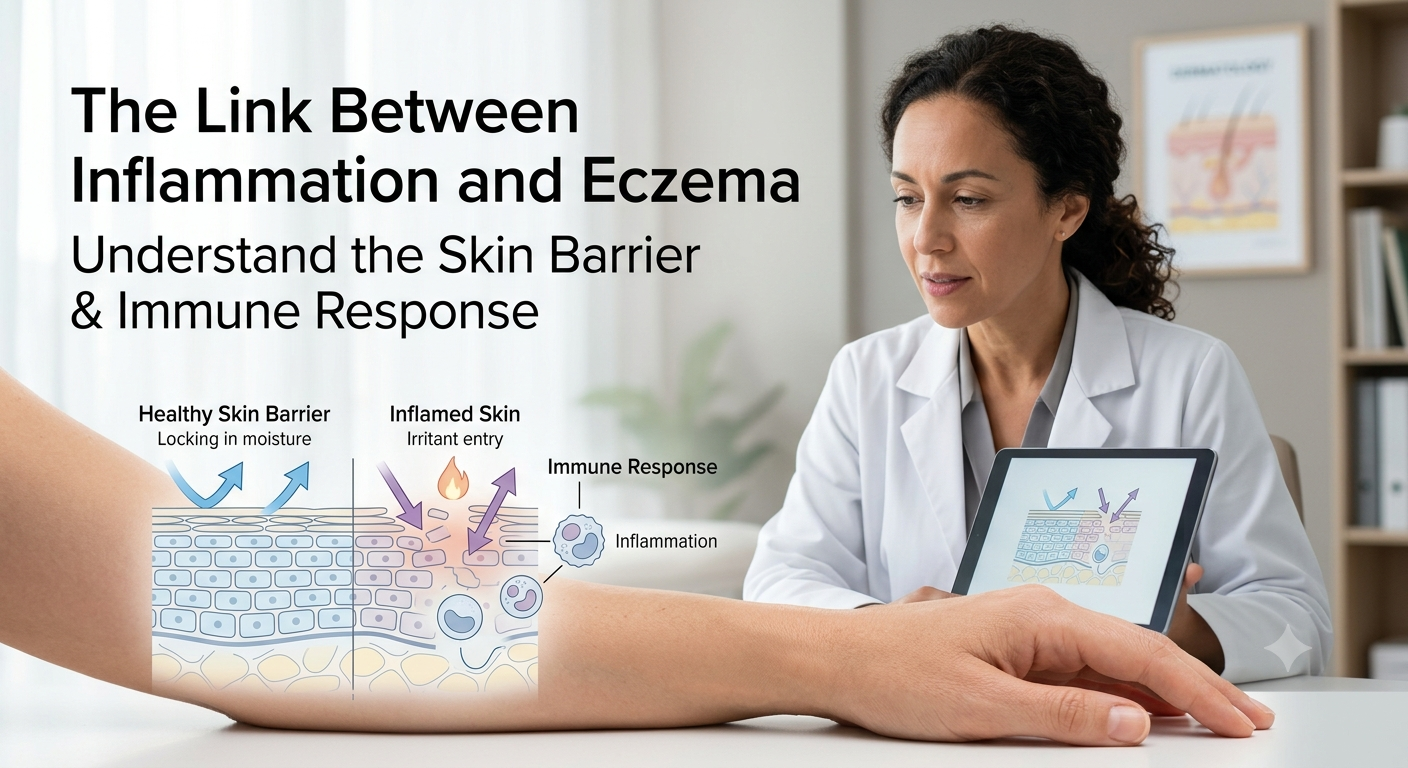
To understand the connection between immune activity and skin irritation, it is essential to look at the eczema skin barrier.
Healthy skin acts like a brick wall: skin cells are the bricks, and lipids (natural oils and fats) serve as the mortar. This barrier locks moisture in and keeps potential irritants, bacteria, and allergens out.
Healthy Skin Barrier                      Disrupted Eczema Barrier
┌───────────────────────┐                ┌ ─ ─ ─ ─ ─ ─ ─ ─ ─ ─ ─ ┐
│  Protective Lipid     │                │  Depleted Lipids      │
│  Layer Keeps Moisture │                │  Allow Moisture Loss  │
│  In & Irritants Out   │                │  & Irritant Entry     │
└───────────────────────┘                └ ─ ─ ─ ─ ─ ─ ─ ─ ─ ─ ─ ┘
In people with eczema, genetic variations (such as alterations in the filaggrin protein) or environmental factors can weaken this barrier:
-
Moisture Escapes: Water evaporates quickly, leading to chronic dryness.
-
Irritants Enter: Microscopic cracks allow soaps, pollen, dust, and microbes to penetrate deeper skin layers.
-
Immune System Triggers: Once foreign particles enter through the compromised barrier, the immune system detects them and triggers an inflammatory response.
Common Factors That May Trigger or Worsen Flares
While inflammation drives symptoms from the inside, external exposures frequently act as eczema triggers. Triggers do not cause eczema on their own, but they can provoke the immune system or further disrupt the skin barrier.
-
Environmental Irritants: Harsh soaps, synthetic detergents, fragrances, wool or rough fabrics, and household cleaning chemicals.
-
Climate & Weather: Low humidity, cold winter air, excessive heat, or heavy sweating.
-
Allergens: Pet dander, dust mites, pollen, or molds.
-
Emotional Stress: Psychological stress prompts the body to release hormones like cortisol, which can alter immune function and heighten skin sensitivity.
Because skin profiles are unique, what triggers a flare-up in one person may have no effect on another.
Overview of Key Eczema Factors
|
Factor |
Possible Role in Eczema |
What to Understand |
|---|---|---|
|
Immune Response |
Releases inflammatory signaling molecules (cytokines) in the skin. |
Drives redness, swelling, and the neurological sensation of itching. |
|
Skin Barrier |
Allows moisture loss and entry of environmental irritants. |
Weakened barrier function makes skin more sensitive to external exposures. |
|
Triggers |
External or internal factors that provoke immune activity. |
Triggers vary widely by individual; identifying them requires personal tracking. |
|
Genetics |
Influences skin structure proteins and immune reactivity. |
Eczema often runs in families alongside asthma or seasonal allergies (the atopic triad). |
Why Eczema Can Vary From Person to Person
Eczema is not caused by a single food, allergen, or environmental toxin. It is a multi-factorial condition where genetic predisposition, immune function, barrier integrity, and lifestyle interact.
Because of this complexity:
-
No Single Miracle Cure: Claims that a specific supplement, detox, elimination diet, or home remedy can permanently cure eczema are unsupported by medical science.
-
Dietary Considerations: While food allergies can coexist with eczema—especially in young children—eliminating entire food groups without medical supervision is not recommended and does not guarantee flare prevention.
How Healthcare Professionals Approach Eczema Management
Managing eczema involves stabilizing the skin barrier, calming active inflammation, and reducing exposure to known irritants. Dermatologists and healthcare providers typically tailor plans based on individual needs and severity:
-
Daily Barrier Support: Applying thick, fragrance-free moisturizers (cermides or ointments) immediately after bathing to lock in hydration.
-
Targeted Anti-Inflammatory Therapies: Utilizing prescription topical treatments (such as topical corticosteroids or non-steroidal topical calcineurin/PDE4 inhibitors) during flares to quiet immune signaling.
-
Advanced Options: For moderate-to-severe cases, clinicians may evaluate phototherapy (light therapy) or systemic medications (biologics or oral treatments) that target specific immune pathways.
-
Gentle Skin Care Routines: Switching to mild, soap-free cleansers and practicing lukewarm bathing.
When to Speak With a Healthcare Professional
You should consult a physician, dermatologist, or allergist if:
-
Skin discomfort interferes with sleep or daily activities.
-
Home care and over-the-counter moisturizers do not improve symptoms.
-
You notice signs of a potential skin infection, such as yellow crusting, oozing, pus, intense pain, or red streaks.
Frequently Asked Questions
Is eczema just skin inflammation?
No. While inflammation causes visible skin redness and itching, eczema involves a combination of immune system dysregulation, structural skin barrier weaknesses, and genetic factors.
Can reducing stress completely prevent eczema flares?
Stress management can significantly reduce flare frequency and intensity by lowering stress-induced inflammatory signals. However, because genetics and environmental factors also play major roles, stress reduction alone cannot guarantee the prevention of all future flares.
Will eliminating dairy or gluten cure my eczema?
There is no universal diet that cures eczema. Unless a healthcare professional or allergist diagnoses a specific food allergy or sensitivity through proper clinical evaluation, restricting your diet is unlikely to eliminate eczema and can lead to nutritional imbalances.
How is atopic dermatitis different from contact dermatitis?
Atopic dermatitis is a chronic, genetically linked inflammatory condition associated with a weakened skin barrier. Contact dermatitis occurs when the skin reacts directly to an external substance—either as an allergic reaction (like poison ivy) or direct irritation (like strong bleach).
Why does eczema itching get worse at night?
Itching often intensifies at night due to natural body rhythm changes, including shifts in body temperature, reduced levels of anti-inflammatory hormones, increased water loss through the skin during sleep, and fewer nighttime distractions.
Navigating Eczema With Clear Information
Living with eczema means understanding that skin flares are a result of complex interactions between immune inflammation and barrier function—not a personal failure of care. By working closely with a qualified healthcare professional, identifying your unique triggers, and maintaining consistent skin hydration, you can effectively manage symptoms and support long-term skin health.