Learn More About 5 Banks Offering Fixed Term Deposits in Singapore
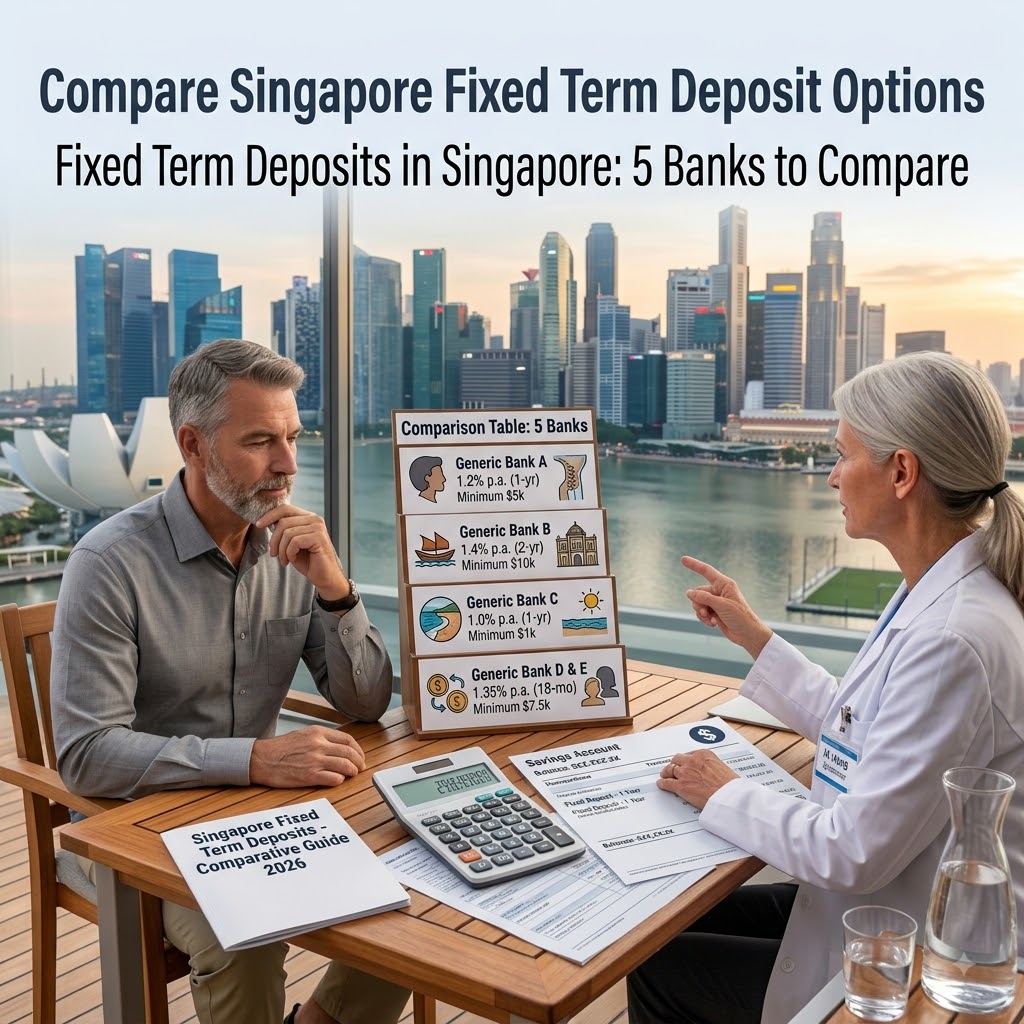
Fixed-term deposits (also called time deposits) offer a low-risk way to lock in a guaranteed return on your SGD cash reserves. Choosing the right offer requires looking beyond the headline percentage—rates shift based on tenure, deposit size, funding type, and tier requirements.
What a Fixed Term Deposit Is and How It Works
A fixed-term deposit is an agreement where you lock up a specified lump sum with a licensed financial institution for a fixed duration at a agreed-upon interest rate.
-
Principal Security: Your capital is guaranteed by the issuing institution.
-
Fixed Rate: Unlike high-yield savings accounts with fluctuating or conditional tiers, the interest rate stays constant for the entire duration.
-
Maturity: At the end of the lock-in period, your initial principal and accrued interest are returned to your account or automatically rolled over into a new term based on your instructions.
Core Variables: Rates, Minimums, and Tenures
Fixed deposit terms vary across three key metrics:
[ Deposit Amount ]  <--->  [ Tenure Length ]  <--->  [ Rate Type ]
  (Min. S$500 to             (3, 6, 9, or           (Promotional vs.
   S$20,000+)                 12 Months)             Board Rates)
-
Tenure: Common options are 3-month, 6-month, 9-month, and 12-month periods. Shorter terms provide quicker liquidity, while longer terms lock in rates if yields drop.
-
Deposit Minimums: Entry thresholds range from S$500–S$1,000 for basic digital placements to S$10,000–S$25,000+ for higher-tier promotional rates.
Comparing Major Singapore Banks
Major local and international retail banks structure their fixed deposit products differently based on target customer segments:
|
Bank |
General Characteristics |
Typical Placement Channel |
|---|---|---|
|
DBS / POSB |
Low minimum entry thresholds (from S$1,000). Baseline rates tend to be conservative compared to foreign competitors. |
Internet / Mobile Banking |
|
OCBC |
Tiered promotional offers often tied to online placements. Minimum amounts typically start around S$20,000. |
Digital Banking & Branches |
|
UOB |
Competitive promotional rates requiring fresh funds. Offers occasionally feature wealth-management bundle options. |
Online & Branch Network |
|
Maybank |
Strong mid-to-long term rates (6 to 12 months). Often features structured bundle promos paired with savings accounts. |
iSAVy Online / Branches |
|
Standard Chartered |
Higher minimum thresholds (often S$25,000+). Rates often cater to priority banking clients or fresh-funds promotions. |
SC Mobile & Priority Centers |
Note: Foreign institutions (such as Bank of China, RHB, and ICBC) or digital-first players frequently offer higher yields to attract deposits compared to the major three local banks.
Promotional Rates vs. Standard Board Rates
Banks maintain two sets of rates:
-
Board Rates: Standard, non-promotional rates published permanently. These are generally low (often under 0.50%–1.00% p.a.) and represent the default auto-renewal rate if a term matures without fresh instructions.
-
Promotional Rates: Limited-time offers that are significantly higher than board rates. Offers fluctuate based on market conditions, bank liquidity needs, and macro interest-rate environments.
Understanding “Fresh Funds” Requirements
To qualify for promotional rates, banks often enforce a Fresh Funds clause:
-
Definition: Money transferred in from another financial institution that was not previously held in any account with that specific bank within a set timeframe (typically 30 days).
-
Transfer Types: Internal transfers between your own accounts within the same bank (e.g., from a current account to a fixed deposit) generally do not count as fresh funds. Transfers via FAST, PayNow, or cashier’s order from an external bank qualify.
Early Withdrawal Conditions & Interest Penalties
Fixed deposits are illiquid by design. Pulling out your capital early carries distinct financial drawbacks:
-
Interest Forfeiture: Banks usually charge an early withdrawal fee or cancel accrued interest entirely.
-
Partial Payments: Some institutions pay a pro-rated baseline board rate for the days held, but forfeit the promotional bonus rate.
-
Capital Protection: While your original principal is safe, early withdrawals can leave you with zero net yield for the period invested.
Deposit Insurance Considerations
Fixed deposits in Singapore carry high capital safety due to statutory protections:
-
SDIC Protection: Eligible SGD fixed deposits held at full banks and finance companies are automatically insured by the Singapore Deposit Insurance Corporation (SDIC) up to S$100,000 per depositor per institution.
-
Institutional Spreading: If you hold cash exceeding S$100,000, splitting funds across separate banking groups ensures full SDIC coverage across your portfolio.
How to Calculate Effective Return (Beyond Advertised Rates)
Advertised rates are expressed as per annum (p.a.), which means a 6-month rate of 1.40% p.a. does not pay 1.40% over 6 months; it pays half that amount.
$$\text{Actual Interest Earned} = \text{Principal} \times \left( \frac{\text{Advertised Rate p.a.}}{100} \right) \times \left( \frac{\text{Tenure in Days}}{365} \right)$$
Comparing True Returns
|
Scenario |
Principal |
Tenure |
Advertised Rate (p.a.) |
Actual Dollars Earned |
|---|---|---|---|---|
|
Bank A |
S$20,000 |
12 Months |
1.30% |
S$260 |
|
Bank B |
S$20,000 |
6 Months |
1.50% |
S$150 |
|
Bank C (Bundled) |
S$20,000 (FD) + S$2,000 (Savings) |
12 Months |
1.55% (on FD only) |
S$310 (minus opportunity cost on uninvested S$2,000) |
Key Takeaways for Evaluation:
-
Opportunity Cost of Bundles: If a higher rate requires keeping extra cash in a low-interest current account, factor in the drag on those auxiliary funds.
-
Compounding & Reinvestment: A 6-month deposit allows you to reinvest earlier, but exposes you to “reinvestment risk” if market rates drop before your term ends.