Guide to Know About Psoriasis Self Care and Skin Comfort
Managing psoriasis effectively involves combining medical treatment with consistent, gentle self-care. While daily routines cannot cure psoriasis—an autoimmune condition where skin cells multiply faster than normal—proper skin care and trigger awareness can reduce plaque buildup, calm itching, and improve overall comfort.
Everyday Skin Care: Bathing and Moisturizing
Keeping the skin’s moisture barrier intact is essential for minimizing cracking, scaling, and dryness.
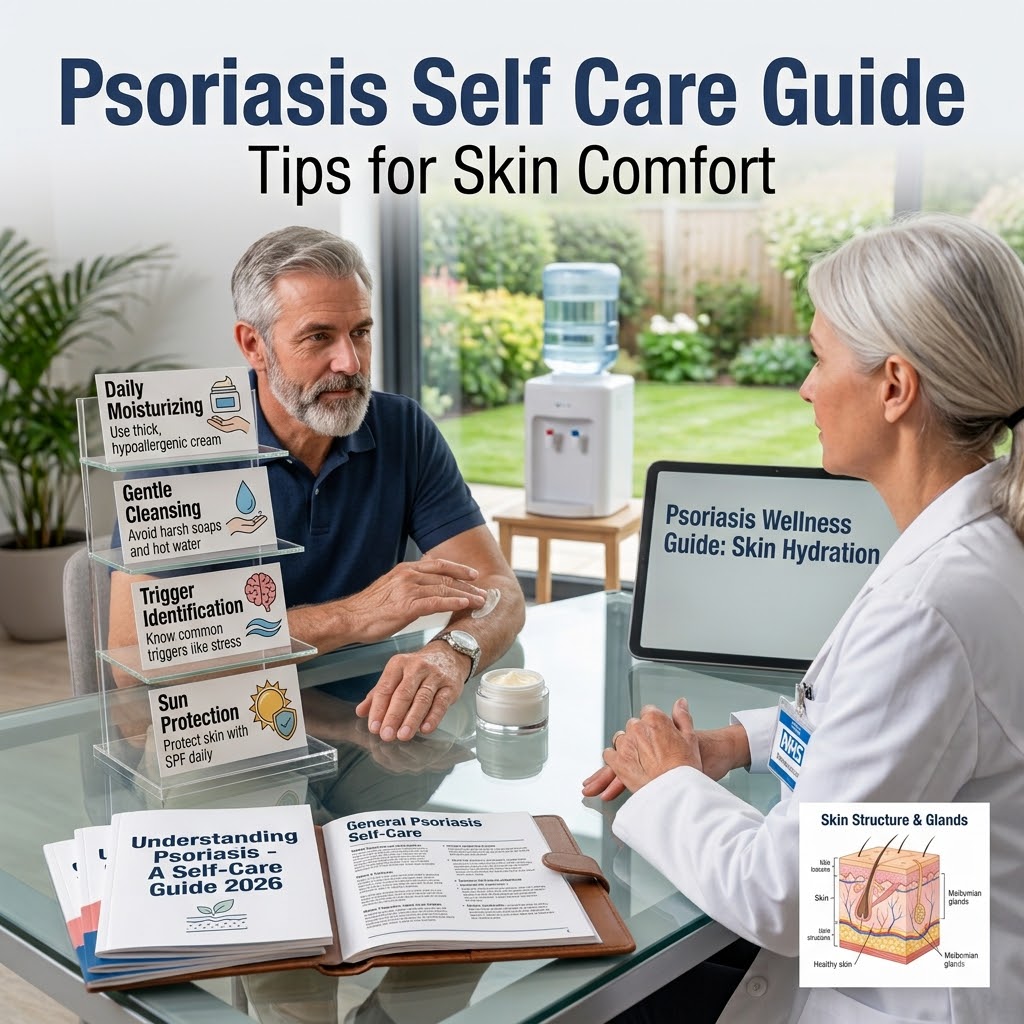
                   [ Daily Skin Care Routine ]
                                |
      +-------------------------+-------------------------+
      |                                                   |
[ Showering & Cleansing ]                         [ Moisture Lock ]
      |                                                   |
• Use warm water (not hot)                        • Apply within 3 minutes of drying
• Keep sessions under 10 minutes                  • Use thick creams or ointments
• Choose fragrance-free cleansers                 • Focus on ceramides & petrolatum
-
Warm, Short Showers: Hot water strips natural lipids from the skin, causing rebound dryness. Limit showers or baths to 5–10 minutes using warm water.
-
Gentle Cleansers: Avoid harsh anti-bacterial soaps or heavily fragranced body washes. Use mild, synthetic detergent (syndet) bars or fragrance-free liquid cleansers.
-
Gentle Drying: Avoid aggressive scrubbing with towels or loofahs, which can irritate plaques. Gently pat the skin dry, leaving a light film of moisture on the surface.
-
Apply Heavy Ointments Immediately: Lock in hydration by applying a thick cream or ointment within 3 minutes of stepping out of the shower. Ingredients like petrolatum, ceramides, hyaluronic acid, and shea butter provide stronger protection than thin lotions.
Managing Itch and Avoiding the Koebner Phenomenon
Itching (pruritus) is one of the most bothersome aspects of psoriasis, but scratching can lead to complications.
-
Cool Compresses: Apply an ice pack wrapped in a clean cloth or a cool, damp towel directly to itchy plaques for 10 minutes to temporarily numb nerve endings.
-
Avoid Scratching: Scratching damages the skin barrier and risks secondary bacterial infections.
-
Prevent the Koebner Phenomenon: People with psoriasis can develop new plaques at sites of skin injury—a response known as the Koebner phenomenon. Protect skin from scratches, bug bites, tight clothing friction, and sunburns.
Identifying and Managing Personal Triggers
Psoriasis flare-ups are frequently linked to specific environmental or physiological triggers:
|
Common Trigger |
Impact on Psoriasis |
Management Strategy |
|---|---|---|
|
Psychological Stress |
Increases systemic inflammation and immune reactivity. |
Practice mindfulness, regular exercise, or stress-reduction techniques. |
|
Cold, Dry Weather |
Low indoor humidity strips skin moisture, worsening scaling. |
Use a cool-mist humidifier indoors during winter months. |
|
Sunburn |
Severe UV damage triggers local skin trauma (Koebner response). |
Apply broad-spectrum SPF 30+ sunscreen daily; get mild, controlled sun exposure. |
|
Skin Injury / Friction |
Cuts, scrapes, or tight waistbands can provoke new plaques. |
Wear loose-fitting cotton clothing and protect hands during manual tasks. |
The Role of Prescription Treatments
Self-care measures support skin comfort, but they do not replace disease-modifying medical therapies. Depending on severity, dermatologists prescribe:
-
Topical Treatments: Corticosteroids, vitamin D analogues (calcipotriene), topical retinoids, or calcineurin inhibitors to reduce inflammation and slow skin cell turnover.
-
Phototherapy: Controlled exposure to prescription UVB light under medical supervision.
-
Systemic & Biologic Therapies: Oral medications or targeted injectable biologics that regulate specific immune pathways in moderate-to-severe cases.
When to Consult a Dermatologist
Self-care should always be coordinated with a healthcare provider. Schedule an evaluation if you experience:
-
Widespread or Spreading Plaques: Plaques that cover large surface areas of your body or fail to respond to over-the-counter moisturizers.
-
Persistent Pain or Bleeding: Cracks in the skin (fissures) that bleed, feel excessively tender, or show signs of infection (pus or heat).
-
Joint Pain or Stiffness: Up to 30% of people with psoriasis develop psoriatic arthritis. If you notice morning joint stiffness, swollen fingers/toes (“sausage digits”), or heel pain, seek prompt evaluation.
How Psoriasis Arthritis Is Diagnosed
There is no single blood test or scan that definitively confirms PsA. Instead, rheumatologists rely on a combination of medical history, physical exams, and diagnostic criteria (such as the CASPAR criteria—Classification Criteria for Psoriatic Arthritis).
                      [ Joint Pain & Stiffness ]
                                  |
         +------------------------+------------------------+
         |                                                 |
[ Physical Evaluation ]                            [ Diagnostic Testing ]
         |                                                 |
• Check skin/nails for psoriasis                   • Blood work (RF, anti-CCP, CRP)
• Inspect entheses (tendon insertion sites)         • X-rays / Ultrasound / MRI
• Look for dactylitis ("sausage digits")            • Joint fluid aspiration (rule out gout)
-
Clinical & Physical Examination:
-
Skin and Nails: Looking for active psoriasis plaques, a history of psoriasis, or subtle nail changes (pitting, crumbling, or detachment from the nail bed).
-
Dactylitis: Swelling of an entire finger or toe, giving it a uniform “sausage-like” appearance—a hallmark sign of PsA.
-
Enthesitis: Inflammation where tendons or ligaments attach to bone, most commonly felt as tenderness at the Achilles tendon or the bottom of the heel (plantar fascia).
-
-
Laboratory Tests:
-
Inflammatory Markers: High levels of C-reactive protein (CRP) or erythrocyte sedimentation rate (ESR) indicate systemic inflammation, though normal levels do not rule out PsA.
-
Serology (Exclusion Testing): Testing for Rheumatoid Factor (RF) and Anti-CCP (anti-cyclic citrullinated peptide) antibodies. PsA is typically seronegative (RF-negative), whereas RA is usually seropositive.
-
-
Imaging Studies:
-
X-rays: Show characteristic bone changes in advanced PsA, such as simultaneous bone erosion and new bone formation (“pencil-in-cup” deformities).
-
Ultrasound & MRI: Detect early tendon inflammation, enthesitis, and joint lining changes before they appear on standard X-rays.
-
Psoriatic Arthritis vs. Rheumatoid Arthritis
While both conditions are autoimmune, chronic, and cause joint pain, stiffness, and fatigue, their underlying mechanisms and physical manifestations differ significantly:
|
Feature |
Psoriatic Arthritis (PsA) |
Rheumatoid Arthritis (RA) |
|---|---|---|
|
Joint Symmetry |
Often asymmetric (e.g., left index finger and right knee) |
Highly symmetric (e.g., both wrists or both hands simultaneously) |
|
Affected Joints |
Frequently involves distal joints (DIP joints closest to fingernails) and the spine/sacroiliac joints |
Spares distal (DIP) joints; focuses heavily on MCP/PIP joints in hands and wrists |
|
Skin & Nails |
Associated with skin psoriasis and nail pitting or ridges |
No skin psoriasis; may develop subcutaneous rheumatoid nodules |
|
Tendons & Entheses |
High occurrence of enthesitis (heel/Achilles pain) and dactylitis |
Rare enthesitis or full-digit swelling |
|
Blood Markers |
Usually negative for RF and Anti-CCP (Seronegative) |
Usually positive for RF and Anti-CCP (Seropositive) |
|
Spine Involvement |
Common (Spondylitis / Sacroiliitis) |
Extremely rare (spares lower back and sacroiliac joints) |
Treatment Approaches
Early diagnosis is critical to prevent permanent joint damage. Both conditions are treated with systemic therapies, but drug selection varies:
-
Nonsteroidal Anti-Inflammatory Drugs (NSAIDs): Provide symptom relief for mild joint stiffness in both conditions.
-
Disease-Modifying Antirheumatic Drugs (DMARDs): Conventional DMARDs (like methotrexate) treat both skin and joint symptoms in PsA and RA.
-
Targeted Biologics: Biologic therapies targeting specific inflammatory pathways—such as TNF inhibitors, IL-17 inhibitors, or IL-23 inhibitors—are highly effective for controlling both skin psoriasis and joint inflammation in PsA.