Guide to Know About Affordable Electricity Plans in Texas in 2026
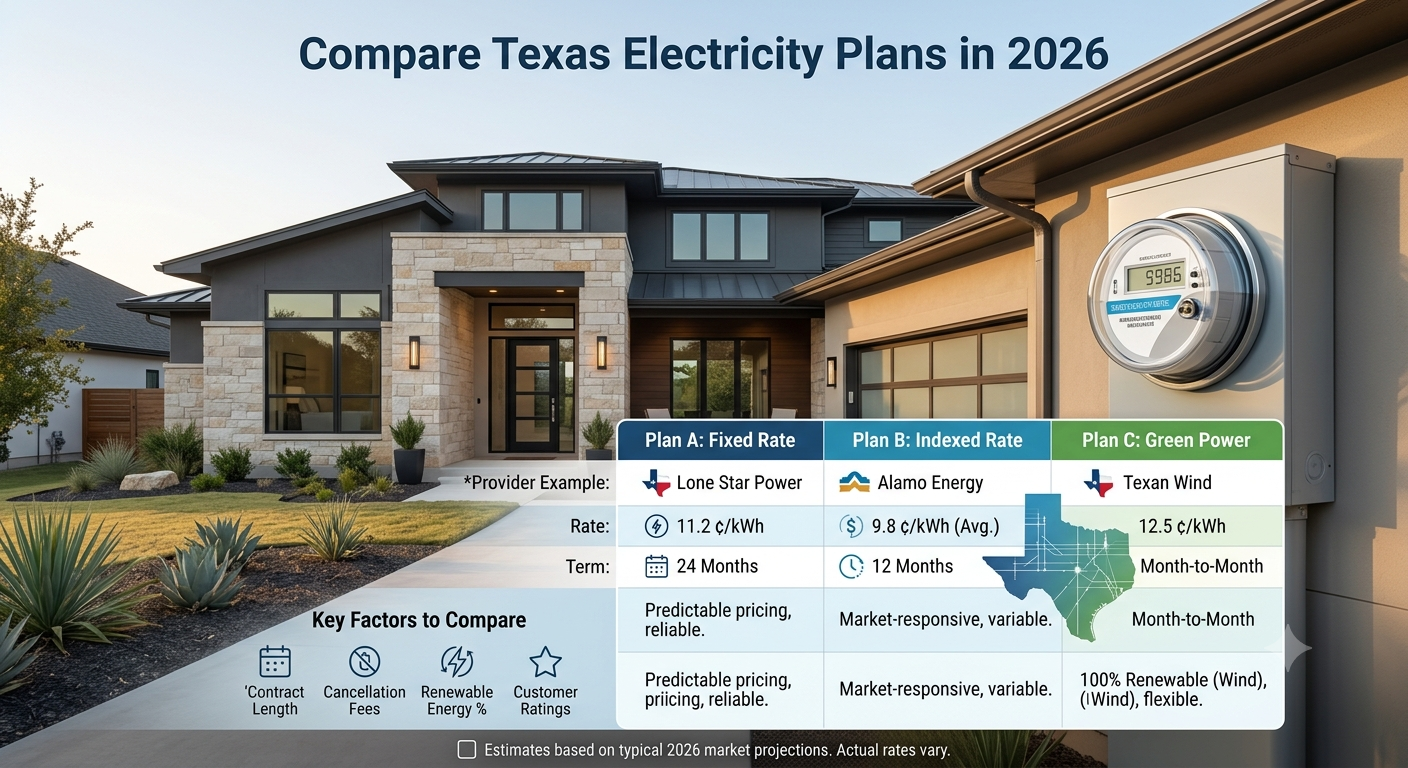
Because Texas operates a deregulated retail electricity market across most of the state, consumers have the freedom to choose their Retail Electric Provider (REP). However, navigating hundreds of available offers requires an understanding of how pricing structures, utility delivery fees, and usage tiers interact to form your final monthly bill.
How Electricity Pricing Works in Texas
Your monthly Texas electric bill consists of two primary operational components:
                   [ Your Monthly Electric Bill ]
                                         |
         +-------------------------------+-------------------------------+
         |                                                               |
 [ Energy Charge (REP) ]                                     [ TDU Delivery Charges ]
 • Retail Electric Provider cost                             • Utility infrastructure fee
 • Fixed, variable, or indexed rate                          • Set by regional utility (e.g., Oncor)
 • Covers power generation & profit                          • Includes monthly base fee + per-kWh rate
-
Retail Electric Provider (REP) Charges: This is the cost for the actual electricity you consume, set by the competitive provider you choose (e.g., TXU, Reliant, Gexa, or Green Mountain).
-
Transmission and Distribution Utility (TDU/TDSP) Charges: These fees are charged by the regulated utility company that maintains the power lines, poles, and meters in your geographic region. These pass-through charges are non-negotiable, set by the Public Utility Commission of Texas (PUCT), and added to your bill regardless of which REP you select.
Why the “Cheapest” Plan Depends on Location and Usage
A plan advertised at a low rate for one household can prove expensive for another due to two factors:
-
TDU Service Territories: Rates vary by geographic region because each utility charges different delivery fees. For instance, homes in the Oncor service area (Dallas/Fort Worth) pay different TDU rates than homes in the CenterPoint Energy territory (Greater Houston).
-
Usage Benchmarks: Rates are modeled at three standardized monthly usage tiers on state disclosures:
-
500 kWh: Typical for small apartments.
-
1,000 kWh: Average for small-to-medium single-family homes.
-
2,000 kWh: Common for large homes, especially during summer cooling months.
-
A plan with a low advertised rate at 1,000 kWh might feature a high base fee that inflates the per-kWh cost if your apartment only uses 400 kWh.
Fixed-Rate vs. Variable-Rate Plans
|
Feature |
Fixed-Rate Plans |
Variable-Rate Plans |
|---|---|---|
|
Price Stability |
Energy rate per kWh stays locked for the full contract term. |
Rate fluctuates monthly based on market conditions and wholesale energy prices. |
|
Budgeting |
Predictable supply costs; protected from seasonal price spikes. |
Unpredictable; bills can surge during extreme summer heatwaves or winter freezes. |
|
Commitment |
Requires locking into a contract (e.g., 6 to 36 months). |
Typically month-to-month with no long-term commitment. |
|
Termination Fees |
Usually carries an Early Termination Fee (ETF) if canceled early. |
No exit fees; cancel or switch anytime. |
Comparing Contract Lengths: 6, 12, 24, and 36 Months
-
6-Month Contracts: Short-term flexibility, but if your contract expires in peak summer or winter, renewal rates may be high.
-
12-Month Contracts: The industry benchmark. Captures a full year of seasonal usage and allows you to re-evaluate annually during favorable shopping windows.
-
24- and 36-Month Contracts: Locks in price stability for multiple years. Ideal during periods of rising natural gas or generation costs, though they carry higher Early Termination Fees if you move or want to switch early.
Advertised Rate vs. Effective Rate (Hidden Mechanics)
The headline price displayed on comparison websites is often an effective rate calculated at a single usage point (typically 1,000 kWh) rather than a flat per-kWh rate.
                [ Advertised Headline Rate: 12.0¢ / kWh ]
                                   |
         +-------------------------+-------------------------+
         |                                                   |
[ Includes Bill Credits ]                           [ Excludes Spikes ]
• Requires EXACTLY 1,000 kWh                        • Dropping to 900 kWh loses credit
• Triggers $100 credit discount                     • Effective rate jumps to 18.5¢ / kWh
Common Plan Triggers to Watch:
-
Bill Credits: Plans may offer a $50 to $100 credit if your monthly usage reaches or exceeds a threshold (e.g., exactly 1,000 kWh). If you use 990 kWh, you miss the credit entirely, causing your effective rate to jump significantly.
-
Minimum Usage Fees: Penalty charges applied if your household consumes less than a set amount (e.g., a $10 fee if usage falls below 500 kWh).
-
Tiered Rates: Plans that charge low rates for the first 1,000 kWh, but charge significantly higher rates for any consumption beyond that mark.
Contract Fine Print & Termination Terms
Before signing an agreement, verify these operational conditions:
-
Early Termination Fees (ETFs): Fixed-rate contracts impose a penalty for canceling before the term ends. ETFs are structured either as a flat fee (e.g., $150–$250) or a recurring charge per month remaining on the contract (e.g., $20/month).
-
Moving Exception: Under PUCT regulations, providers must waive the ETF if you provide proof that you are moving out of the service address before the contract ends.
-
Contract Expiration Warnings: REPs must send notice before your contract expires. If you take no action, you will be moved to a costly default variable “rollover” rate.
Seasonal Timing Matters
Texas electricity wholesale prices correlate with temperature and demand:
-
Peak Seasons (Summer & Winter): High temperatures drive air conditioning usage, raising wholesale power costs and the retail fixed rates offered to new customers.
-
Shoulder Seasons (Spring & Fall): Mild weather lowers grid demand. Shopping for a multi-month contract during spring (March–May) or fall (September–November) often yields lower locked-in rates.
How to Use the Electricity Facts Label (EFL)
The Electricity Facts Label (EFL) is a mandatory standardized document required for every plan sold in Texas. Modeled after a nutrition label, it exposes true plan costs.
+-----------------------------------------------------------------------+
|                       ELECTRICITY FACTS LABEL (EFL)                   |
+-----------------------------------------------------------------------+
| Average Monthly Use:                 500 kWh    1,000 kWh   2,000 kWh |
| Average Price per kWh:               15.2¢        12.1¢       14.5¢   |
+-----------------------------------------------------------------------+
| Base Charge: $4.95 per month                                          |
| Energy Charge: 8.2¢ per kWh                                           |
| TDU Delivery Charge: 4.5¢ per kWh + $4.39 per month                   |
| Bill Credit: $50 credit per billing cycle applied at 1,000+ kWh       |
+-----------------------------------------------------------------------+
What to Check on the EFL:
-
The 3 Usage Rows: Compare the cents-per-kWh price at 500, 1,000, and 2,000 kWh. If the rate varies significantly between tiers, the plan relies on credits or tiered penalties.
-
Base Charge Line: Look for recurring monthly fees charged by the provider regardless of usage.
-
TDU Pass-Through Disclosure: Ensure TDU charges are listed clearly as separate pass-through items or incorporated into the rate calculation.
-
Product Type: Confirm whether the plan is listed as Fixed, Variable, or Indexed.
Step-by-Step Shopping Strategy
-
Gather Past Usage Data: Log into your current utility account or Smart Meter Texas to review your historical kWh consumption for the last 12 months (focusing on low spring/fall months vs. peak summer months).
-
Ignore Headline Advertisements: Do not pick a plan based on the large front-page percentage or rate claim.
-
Open the EFL Document: For any finalist plan, click the direct link to open its Electricity Facts Label PDF.
-
Calculate Costs Based on Your Real Data: Multiply your actual historical monthly kWh numbers by the plan’s formula to determine what your real annual cost would have been.
-
Select a Flat, Uncomplicated Rate: For predictable billing, choose plans with a simple per-kWh charge and standard TDU pass-throughs, avoiding complex bill credits or usage-gated discounts.