30kW Diesel Generators: What to Know Before You Buy
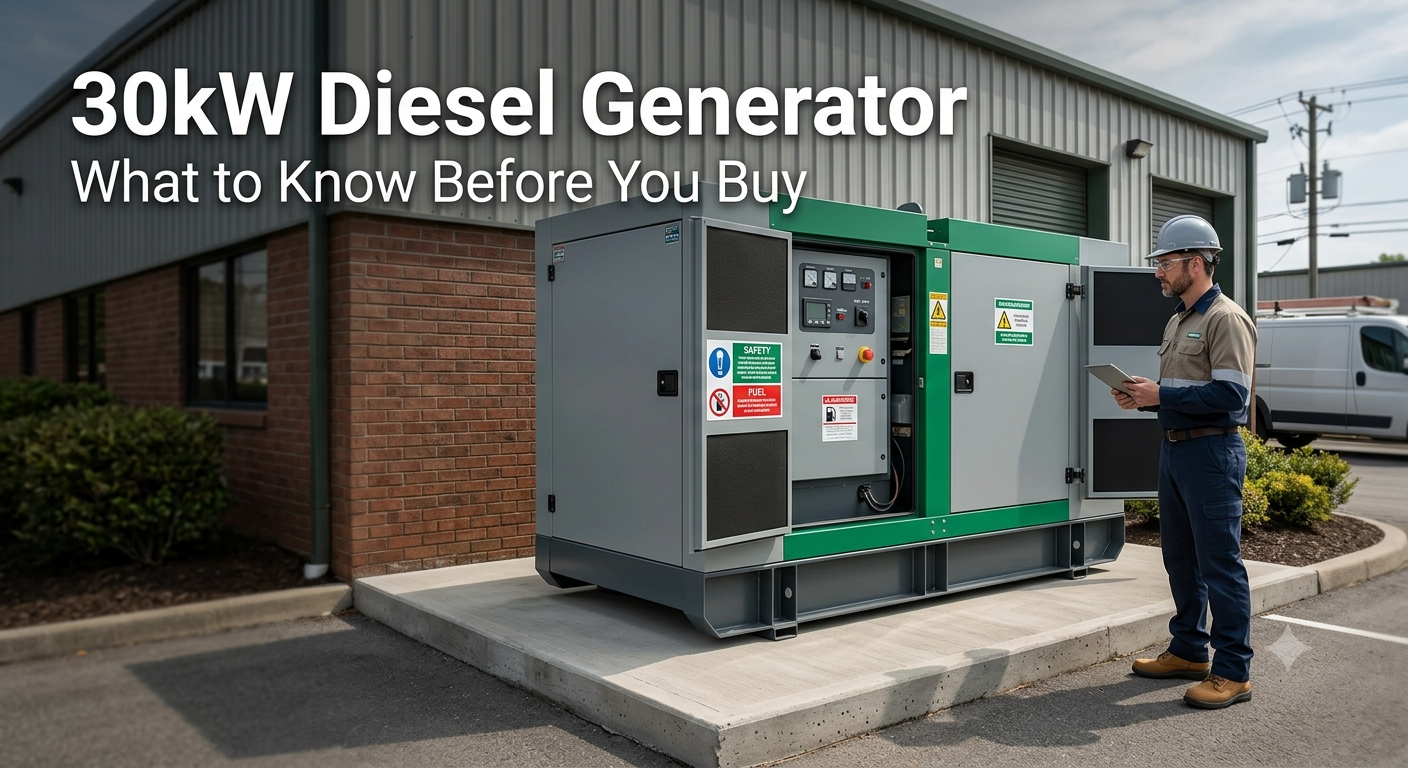
A 30kW diesel generator provides mid-sized commercial, industrial, agricultural, and residential sites with robust emergency backup or prime power. Providing 30,000 watts of continuous electrical power, this generator capacity serves as a reliable solution for facilities that exceed the capacity of portable units but do not require large megawatt-scale industrial gensets.
Finding the right unit involves balancing electrical demand calculations, fuel infrastructure, noise restrictions, and proper system installation.
Understanding 30kW Generator Capacity
A 30kW generator delivers 30 kilowatts (or 30,000 watts) of active electrical power. When sizing a unit, distinguish between two primary output ratings:
-
Rated (Continuous / Prime) Power: The maximum wattage the generator can sustain continuously under variable electrical loads during long-duration outages or off-grid operations.
-
Standby (Surge / Peak) Power: The short-term maximum wattage the generator can supply for brief spikes, such as when heavy electric motors or compressors first kick on. Standby ratings are typically 10% higher than prime power ratings.
Phase and Voltage Compatibility
A 30kW generator for business or residential use is manufactured in two electrical configurations:
-
Single-Phase (120V / 240V): Standard for large residential estates, retail stores, small office buildings, and light agricultural setups.
-
Three-Phase (120V/208V or 277V/480V): Required for industrial sites, workshops, telecommunications towers, and facilities running heavy machinery or three-phase electric motors.
What Can a 30kW Generator Power?
A 30kW generator does not automatically power every appliance on a property simultaneously. Capacity depends on total combined running wattage and starting surge demands.
Common Applications
-
Small Commercial Facilities: Keeps retail spaces, gas stations, clinics, branch offices, and restaurants operating by running refrigeration, point-of-sale systems, lighting, and HVAC systems.
-
Construction & Workshops: Powers multiple heavy-duty power tools, air compressors, welders, and job site trailers simultaneously.
-
Agricultural Operations: Supports grain augers, milk cooling equipment, automated feeding systems, and well pumps.
-
Telecommunications & IT: Serves as critical standby power for cell towers, radio stations, and small server rooms.
-
Large Estates & Luxury Residences: Powers central air conditioning systems, deep well pumps, appliances, and home automation systems during prolonged grid outages.
[Total Electrical Load Calculation]
   ├── Running Loads (Lights, IT, Heating)
   └── Motor Startup Loads (HVAC, Compressors, Pumps) ──► Require 2x-4x Surge Allowance
Note: Motors, pumps, and HVAC equipment require two to four times their running wattage during startup. Failure to account for starting surge can stall the engine or trip circuit breakers.
Standby vs. Prime Power Generators
Selecting the right generator type depends on how frequently it will run:
-
30kW Standby Generator: Permanently installed on a concrete pad outside a building, wired through an Automatic Transfer Switch (ATS). It monitors utility power 24/7 and starts within seconds of an outage. Standby units are rated assuming a reliable primary grid is present.
-
Prime Power Generator: Built for continuous, off-grid operation (such as remote job sites, mobile operations, or oil fields). These engines are engineered to run for extended periods as the primary source of electricity.
Diesel Fuel Considerations
Diesel engines are preferred for critical backup power due to fuel stability, high engine torque, thermal efficiency, and long service life.
-
Fuel Consumption: Depending on engine design and load percentage, a typical 30kW diesel generator consumes approximately 1.5 to 2.0 gallons (5.7 to 7.6 liters) per hour at 50% load, and around 2.5 to 3.5 gallons (9.5 to 13.2 liters) per hour under full 100% load.
-
Fuel Storage & Quality: Diesel fuel can be stored safely on-site, but standing fuel absorbs moisture and supports microbial growth over time. Using fuel stabilizers, biocide treatments, and fuel polishing systems is essential for standby reliability.
-
Runtime: On-board belly tanks (integrated underneath the generator enclosure) usually range from 50 to 100+ gallons, providing 18 to 40 hours of continuous runtime at half load without refueling.
Key Generator Features to Compare
|
Feature |
What It Means |
Why It Matters |
|---|---|---|
|
Power & Phase Rating |
Output wattage and single-phase vs. three-phase wiring. |
Must match your building’s main electrical panel and voltage. |
|
Standby vs. Prime Rating |
Design intent for emergency backup vs. daily continuous use. |
Prevents engine strain and preserves manufacturer warranty terms. |
|
Automatic Transfer Switch |
Module that switches power source during an outage. |
Enables automatic, unattended power restoration within seconds. |
|
Weather/Sound Enclosure |
Protective aluminum or steel housing with acoustic baffles. |
Protects components from weather; dampens sound level down to 65-75 dBA. |
|
Digital Controller |
Electronic interface monitoring voltage, oil, and engine health. |
Displays active telemetry, fault warnings, and remote monitoring options. |
|
Fuel Tank Capacity |
Volume of the sub-base (belly) fuel tank. |
Dictates continuous operational runtime before refueling is needed. |
|
Maintenance Access |
Side-hinged access doors and drain extension hoses. |
Simplifies routine oil, filter, coolant, and battery check services. |
Installation and Safety Considerations
Exhaust and Ventilation
Diesel generators produce hazardous exhaust gases, including carbon monoxide (CO). Generators must never be operated indoors or inside enclosed structures. Install units outdoors with exhaust ports directed safely away from building air intakes, doors, and windows.
Transfer Switches & Grid Isolation
Connecting a commercial diesel generator directly to a building requires an approved transfer switch (manual or automatic). Connecting a generator directly to a building outlet without an isolation switch (known as backfeeding) can energize utility power lines, creating a fatal electrocution hazard for utility line workers.
Compliance & Qualification
All electrical connections, fuel line plumbing, and pad construction must be performed by licensed electricians and certified technicians in compliance with local electrical, building, fire, and environmental codes.
Maintenance Requirements
Regular maintenance ensures your generator starts instantly during a emergency grid failure:
-
Routine Inspection (Monthly): Check engine oil level, coolant level, battery charge voltage, and inspect for hose/belt wear or fuel leaks.
-
Automatic Exercising (Weekly/Bi-Weekly): Program the controller to exercise the engine for 15-20 minutes without load to keep internal seals lubricated and battery charged.
-
Annual Service: Replace engine oil, oil filters, fuel filters, and air filters. Perform load-bank testing if the unit rarely runs under heavy load to prevent “wet stacking” (unburned fuel buildup in the exhaust system).
Diesel Generator Buying Checklist
Use this checklist when consulting manufacturers and electrical contractors:
-
[ ] Calculate Electrical Load: Sum total running watts plus peak starting surge watts for all critical circuits.
-
[ ] Verify Phase & Voltage: Confirm whether your site requires single-phase ($120/240\text{V}$) or three-phase ($120/208\text{V}$ or $277/480\text{V}$).
-
[ ] Determine Duty Type: Select Standby for grid backup or Prime for continuous off-grid power.
-
[ ] Select Transfer Switch: Size the Automatic Transfer Switch (ATS) to match your main electrical service amperage (e.g., 200A or 400A).
-
[ ] Evaluate Clearance & Placement: Ensure outdoor installation meets local setback rules, clearance from flammable walls, and acoustic zoning limits.
-
[ ] Fuel Storage Planning: Size the fuel tank to meet minimum local emergency runtime guidelines (typically 24 to 72 hours).
-
[ ] Total Cost of Ownership: Account for delivery, concrete pad installation, electrical wiring, ATS hardware, permits, and annual maintenance contracts beyond the base purchase price.
FAQ
What can a 30kW generator power?
A 30kW generator can power a small commercial facility, a retail storefront, an agricultural facility, or a large home with central HVAC, refrigeration, well pumps, lighting, and computing systems simultaneously, provided total surge demands stay within limits.
How much diesel does a 30kW generator use per hour?
At 50% load, a typical 30kW diesel generator uses approximately 1.5 to 2.0 gallons per hour. Under a full 100% load, consumption rises to roughly 2.5 to 3.5 gallons per hour depending on engine efficiency.
Is 30kW enough to run a business?
It depends on the business type. It is usually sufficient for small offices, clinics, retail shops, and gas stations. Manufacturing plants or large industrial facilities with heavy machinery require much larger generators.
What is the difference between standby and prime power?
Standby generators act as backup power during temporary utility outages. Prime power generators are built as the primary source of electricity for off-grid operations.
Do I need an automatic transfer switch (ATS)?
If using a standby generator for seamless utility backup, an ATS is recommended. It detects a power outage, automatically signals the generator to start, and safely transfers the building’s electrical load without manual intervention.
How much space does a 30kW diesel generator need?
The unit footprint typically measures around 6 to 8 feet in length and 3 feet in width. However, safety and maintenance codes generally require 3 to 5 feet of clear workspace around all sides of the unit for ventilation and technician access.
Conclusion
A 30kW diesel generator provides reliable power for commercial sites, farms, and large properties during unexpected outages. By calculating your real-world electrical load, selecting the right phase configuration, and hiring qualified professionals for installation, you can build a resilient backup system tailored to your long-term energy needs.