10kW Silent Diesel Generators: What to Compare Before Buying
Selecting a reliable backup or primary power source requires balancing power capacity, noise reduction, and long-term operating costs. A 10kW silent diesel generator is one of the most versatile choices for residential homes, small businesses, agricultural operations, and construction sites.
However, buying a diesel generator involves more than matching a single wattage number to your home or equipment. Navigating rated continuous power versus maximum output, phase configurations, noise ratings, and fuel consumption is critical to securing a system that performs safely and reliably when you need it most.
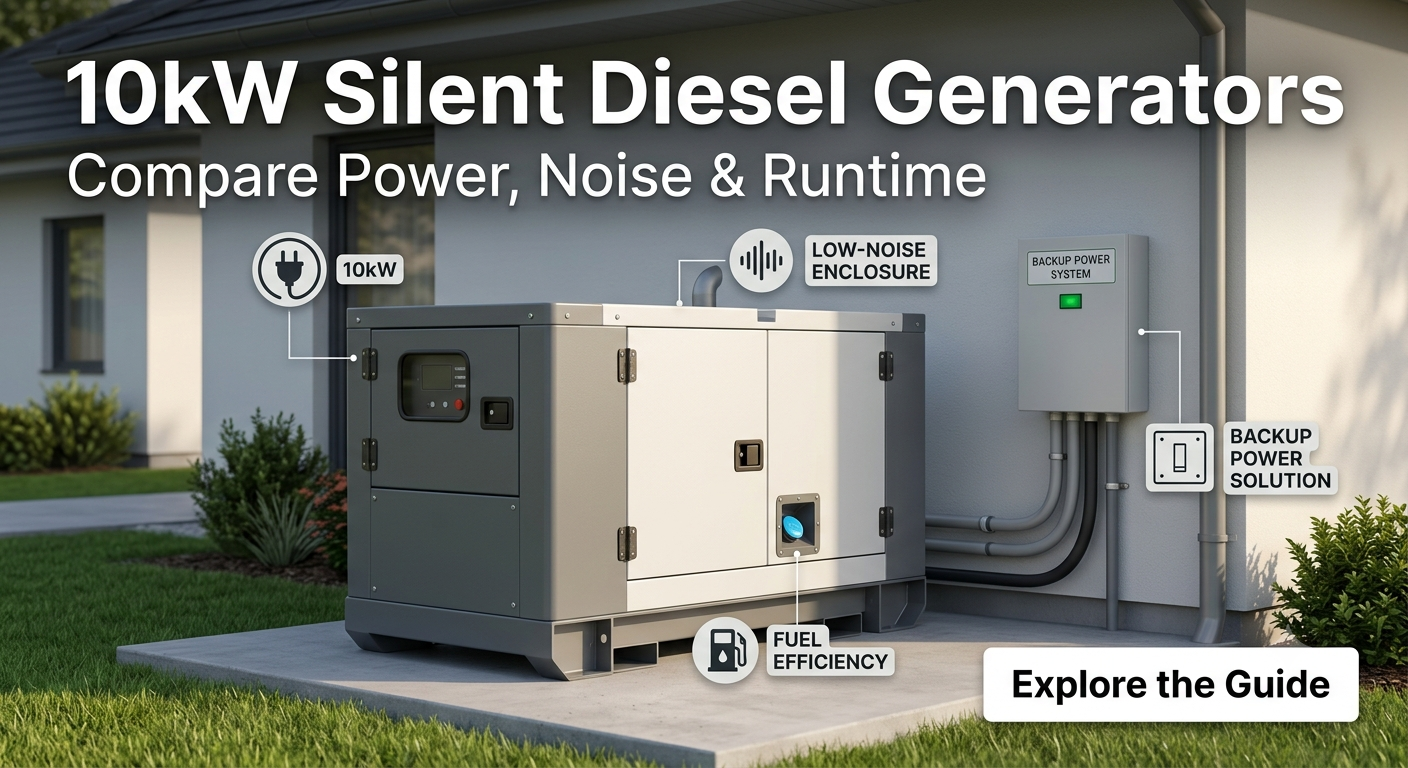
What Is a 10kW Silent Diesel Generator?
A 10kW diesel generator combines a diesel-fueled internal combustion engine with an alternator to generate approximately 10,000 watts of electrical power.
The term “silent” (or “soundproof”) does not mean the unit operates in complete silence. Instead, it indicates that the generator is enclosed in a specialized acoustic canopy or sound-attenuating cabinet designed to muffle engine combustion, mechanical vibration, intake air, and exhaust noise.
                   ACOUSTIC CANOPY BREAKDOWN
 ┌─────────────────────────────────────────────────────────────┐
 │  Heavy-Gauge Steel Outer Shell                             │
 │  ┌───────────────────────────────────────────────────────┐  │
 │  │ Sound-Absorbing Sound Foams / Rockwool Insulation     │  │
 │  │  ┌─────────────────────────────────────────────────┐  │  │
 │  │  │ Heavy-Duty Residential Muffler & Vibration Pads │  │  │
 │  │  └─────────────────────────────────────────────────┘  │  │
 │  └───────────────────────────────────────────────────────┘  │
 └─────────────────────────────────────────────────────────────┘
Without an enclosure, an open-frame 10kW diesel engine produces high-decibel noise levels that make it unsuitable for residential areas or close-quarters workplaces. Silent enclosures make these units viable options for neighborhood backup power, commercial facilities, and quiet working environments.
What Does a 10kW Generator Actually Power?
A 10kW generator offers substantial output, but whether it can power a specific facility depends entirely on the combined running wattage and the initial starting (surge) wattage of all connected appliances.
                          TYPICAL LOAD CAPACITIES
 ┌─────────────────────────────────────────────────────────────────────────┐
 │ RESIDENTIAL              COMMERCIAL / WORKSHOP      AGRICULTURAL        │
 │ • Refrigerator / Freezer │ • Computers & Servers    │ • Water Pumps     │
 │ • HVAC System (3–5 Ton)  │ • LED Lighting Circuits  │ • Ventilation     │
 │ • Sump Pump & Well Pump  │ • Power Tools & Drills   │ • Feeding Systems │
 │ • Essential Circuits     │ • Security Systems       │ • Milking Machines│
 └─────────────────────────────────────────────────────────────────────────┘
-
Inductive Loads Require Extra Surge: Devices with electric motors—such as central air conditioners, well pumps, air compressors, and refrigeration compressors—draw two to three times their normal running wattage for a few seconds during startup.
-
Load Assessment Required: A 10kW unit cannot automatically power an entire large home with all high-draw appliances running simultaneously (e.g., clothes dryer, electric oven, water heater, and central AC all turned on at once). A proper total load calculation is necessary prior to purchase.
Rated Output vs. Maximum Output
One of the most critical distictions when evaluating any 10kW diesel generator is the difference between its Rated (Continuous/Prime) Output and its Maximum (Standby/Peak) Output.
                   POWER OUTPUT DISTINCTION
 ┌──────────────────────────────────────────────────────────────┐
 │  MAXIMUM / STANDBY OUTPUT                                    │
 │  • Peak limit available for short durations (e.g., 10.0 kW)  │
 │  • Handles temporary motor starting surges                   │
 ├──────────────────────────────────────────────────────────────┤
 │  RATED / CONTINUOUS / PRIME OUTPUT                           │
 │  • True continuous capacity for sustained operation (e.g., 9.5 kW) │
 │  • Basis for sizing long-term electrical loads               │
 └──────────────────────────────────────────────────────────────┘
-
Rated Output (Continuous or Prime Power): The maximum electrical power the generator can deliver continuously under specified operating conditions for an unlimited or extended period.
-
Maximum Output (Standby or Surge Power): The peak output the unit can produce for short durations to help start electric motors or handle brief surges.
Example: A generator marketed as a “10kW diesel generator” may have a 10kW maximum output, but its rated continuous output might be 9.5kW (or lower depending on ambient temperature and altitude derating).
kW vs. kVA
-
kW (Kilowatts): Real power—the actual power that performs work.
-
kVA (Kilovolt-Amperes): Apparent power—the total power supplied to the system, combining real power and reactive power.
-
Power Factor (PF): For single-phase generators, power factor is typically 1.0 ($1\text{ kW} = 1\text{ kVA}$). For standard three-phase generators, power factor is rated at 0.8. A three-phase unit rated at $10\text{ kVA}$ at a 0.8 PF delivers $8\text{ kW}$ of real power ($10 \times 0.8 = 8\text{ kW}$). Always verify whether a spec sheet cites kW or kVA.
What Makes a Diesel Generator “Silent”?
A soundproof diesel generator relies on several engineering components to attenuate noise:
-
Acoustic Enclosure: A heavy-gauge steel or aluminum weather-proof shell lined with fire-retardant sound-absorbing foam or rockwool.
-
Residential-Grade Muffler: An internal baffle exhaust system designed to dampen high-frequency combustion noise.
-
Vibration Isolation: Anti-vibration rubber mounts installed between the engine/alternator assembly and the sub-base frame to eliminate structural resonance.
-
Airflow Baffles and Cooling Design: Curved air intake and discharge louvers that allow sufficient cooling airflow while trapping sound waves inside the canopy.
-
Low-Noise Cooling Fan: Aerodynamically optimized fans designed to pull heat away without generating excessive wind noise.
Expected Sound Levels
Noise is measured in decibels (dB) using a logarithmic scale, typically specified at a standard distance of 7 meters (approx. 23 feet). Current 10kW silent diesel generators generally register between 68 dB(A) and 75 dB(A) at 7 meters, roughly equivalent to the ambient sound of a vacuum cleaner or normal highway traffic.
Key Specifications to Compare
When evaluating different silent generator specifications, use the following framework to compare models side by side:
|
Specification |
Why It Matters |
What to Check / Verify |
|---|---|---|
|
Rated kW |
Real, continuous usable power |
Ensure it meets your full running load without overloading |
|
Maximum kW |
Short-term surge capacity |
Confirms capacity to start heavy motor loads |
|
kVA / Power Factor |
Total apparent power rating |
Check power factor (1.0 vs 0.8) to calculate true usable kW |
|
Voltage & Frequency |
Electrical system compatibility |
Verify single-phase (120/240V, 50Hz/60Hz) or three-phase |
|
Phase Configuration |
System wiring match |
Single-phase for standard residential; three-phase for commercial |
|
Noise Level [dB(A) @ 7m] |
Acoustic impact on surroundings |
Compare decibel ratings and distance specifications |
|
Fuel Tank Capacity |
Operating window between fills |
Larger tanks allow overnight or extended continuous operation |
|
Fuel Consumption Rate |
Long-term running expense |
Compare fuel burn at 50%, 75%, and 100% rated loads |
|
Starting System |
Reliability and automation |
Electric key start standard; verify ATS remote-start connectivity |
|
Cooling System |
Thermal stability and lifespan |
Air-cooled (lighter, basic) vs. Liquid-cooled (durable, continuous duty) |
|
ATS Compatibility |
Automatic utility outage transfer |
Look for a dedicated ATS signal port and internal contactor support |
|
Dimensions & Weight |
Installation footprint & delivery |
Confirms site fit, pad requirements, and unloading equipment needs |
Single-Phase vs. Three-Phase
Choosing the wrong phase configuration can render a generator unusable for your electrical infrastructure.
                      PHASE CONFIGURATIONS
 ┌─────────────────────────────┐ ┌─────────────────────────────┐
 │        SINGLE-PHASE         │ │         THREE-PHASE         │
 │ • 120V / 240V Configurations│ │ • 208V / 480V (or 415V/240V)│
 │ • Residential & Small Office│ │ • Commercial & Industrial   │
 │ • Standard Home Breakers    │ │ • Heavy 3-Phase Motors      │
 └─────────────────────────────┘ └─────────────────────────────┘
Single-Phase (120V / 240V)
-
Applications: Standard residential homes, small retail shops, mobile service trucks, and basic farm buildings.
-
Benefits: Matches standard residential service panels. All 10kW capacity can be drawn across standard single-phase circuits.
Three-Phase (e.g., 120/208V, 277/480V, or 240/415V)
-
Applications: Commercial facilities, machine shops, agricultural pumping stations, and industrial sites running three-phase motors or machinery.
-
Consideration: If a three-phase generator is used to power single-phase residential loads, the total power must be carefully balanced across all three legs. Drawing single-phase power from a three-phase generator often limits usable single-phase output to roughly one-third to two-thirds of the generator’s total capacity.
Fuel Consumption & Runtime
Fuel consumption varies based on total load demand, engine displacement, ambient operating conditions, and maintenance levels. Diesel engines are notably more fuel-efficient under heavy loads compared to equivalent gasoline units.
                    TYPICAL FUEL CONSUMPTION TRAJECTORY
 ┌─────────────────────────────────────────────────────────────┐
 │   100% Load  │  ████████████████████████████████  (~0.8–1.0 gal/hr) │
 │    75% Load  │  ████████████████████████          (~0.6–0.8 gal/hr) │
 │    50% Load  │  ████████████████                  (~0.4–0.6 gal/hr) │
 └─────────────────────────────────────────────────────────────┘
Estimating Runtime: To calculate total runtime, divide the total fuel tank capacity by the estimated fuel consumption rate at your average load percentage:
$$\text{Runtime (Hours)} = \frac{\text{Fuel Tank Capacity (Gallons or Liters)}}{\text{Fuel Consumption Rate at Average Load (Gal/hr or L/hr)}}$$
For example, a generator equipped with a 6-gallon (22.7-liter) fuel tank consuming 0.5 gallons (1.89 liters) per hour at 50% load will yield approximately 12 hours of continuous operation per tank.
Automatic Transfer Switch (ATS)
An Automatic Transfer Switch (ATS) monitors utility power entering a facility. When a power outage occurs, the ATS automatically isolates the main utility line, signals the backup generator to start, and transfers the building’s electrical load to generator power. When grid power is restored, the ATS safely transfers the load back and signals the generator to shut down after a cool-down cycle.
                  AUTOMATIC TRANSFER SWITCH (ATS) FLOW
 ┌───────────────┐        Power Outage         ┌────────────────┐
 │ Utility Power ├────────────────────────────►│  ATS Detects   │
 └───────────────┘                             └───────┬────────┘
                                                       │ Signals Start
 ┌───────────────┐                             ┌───────▼────────┐
 │ Facility Load │◄────────────────────────────┤ 10kW Generator │
 └───────────────┘        Transfers Load       └────────────────┘
-
Why an ATS Is Essential for Backup Power: Eliminates the need to manually start the engine, switch main breakers, or run extension cords during severe weather or overnight outages.
-
Safety Mandate: An ATS prevents dangerous backfeeding—the illegal and hazardous energization of utility lines that threatens utility workers trying to restore power.
-
Professional Installation Required: An ATS must be installed by a licensed electrician in compliance with national and local electrical codes.
Applications for 10kW Silent Diesel Generators
-
Home Backup Power: Runs essential circuits, refrigeration, lighting, well pumps, heating systems, and central AC during utility outages.
-
Small Businesses: Keeps point-of-sale systems, security networks, cold storage, and office computers online during blackouts.
-
Farms and Agricultural Facilities: Powers water supply pumps, automated ventilation fans, livestock heating, and milking equipment in remote locations.
-
Construction & Outdoor Jobsites: Supplies quiet, continuous power for high-draw electric power tools, site lighting, air compressors, and office trailers.
-
Telecom & Remote Infrastructure: Serves as prime or standby power for off-grid cell towers, radio repeaters, and remote monitoring stations.
Installation Considerations
Operating a 10kW diesel generator safely requires careful site preparation and compliance with local building codes.
                      INSTALLATION REQUIREMENTS
 ┌─────────────────────────────────────────────────────────────┐
 │ 1. OUTDOOR LOCATION ONLY   Never operate indoors or near    │
 │                            open windows/doors.              │
 │ 2. SOLID FOUNDATION        Concrete pad or stable, level    │
 │                            engineered gravel base.          │
 │ 3. EXHAUST & CLEARANCE     Minimum 3 to 5 ft clearance from │
 │                            combustible structures.          │
 │ 4. CODE COMPLIANCE         Work completed by a licensed     │
 │                            electrician with proper permits. │
 └─────────────────────────────────────────────────────────────┘
-
Location: Install the generator outdoors on a level concrete pad or compacted gravel base capable of supporting its weight (which can range from 400 lbs to over 1,000 lbs depending on whether it is air-cooled or liquid-cooled).
-
Exhaust Safety & Clearances: Maintain recommended clearance (typically a minimum of 3 to 5 feet) from walls, structures, and combustible materials to allow proper cooling airflow and prevent heat buildup.
-
Carbon Monoxide Warning: NEVER install or operate a diesel generator indoors, in garages, basements, or enclosed structures. Diesel exhaust contains hazardous gases, including Carbon Monoxide (CO). Exhaust outlets must be directed away from occupied buildings, doors, windows, and fresh-air intakes.
-
Grounding: Connect the generator to an approved grounding electrode in accordance with local electrical regulations.
Maintenance Guidelines
Diesel engines are renowned for long-term durability, often lasting thousands of hours when serviced according to manufacturer schedules.
                     ROUTINE MAINTENANCE CHECKLIST
 ┌─────────────────────────────────────────────────────────────┐
 │ EVERY 50–100 HOURS   Check/change engine oil & oil filter   │
 │ EVERY 200–250 HOURS  Replace fuel & air filters; test battery │
 │ MONTHLY / QUARTERLY  Run under load for 20–30 minutes       │
 │ ANNUALLY             Inspect cooling system & electricals   │
 └─────────────────────────────────────────────────────────────┘
-
Engine Oil & Filter: Inspect oil levels before every startup. Change oil and filter after an initial break-in period (usually 20–50 hours) and every 100–250 hours of operation thereafter, depending on manufacturer specifications.
-
Fuel System: Replace fuel filters regularly. Diesel fuel can degrade or accumulate water condensation over time; treat stored fuel with fuel stabilizers and biocide treatments if held for longer than six months.
-
Air Filter: Inspect and clean or replace the air intake filter, especially when operating in dusty jobsite conditions.
-
Battery Maintenance: Keep the electric-start 12V battery charged via an integrated trickle charger during standby periods to ensure prompt starting.
-
Periodic Exercise Runs: Run the generator under load for 20–30 minutes once a month to circulate lubricants, burn off internal moisture, and confirm system readiness.
10kW Silent Diesel Generator Price Considerations
Prices for 10kW silent diesel generators vary widely based on engine design, alternator quality, cooling system, and build standard.
Price Factors
-
Engine Type & Speed: Air-cooled 3,600 RPM units are lighter and more economical upfront ($3,000 – $6,000), whereas heavy-duty liquid-cooled 1,800 RPM units offer longer lifespans ($7,000 – $12,000+).
-
Canopy & Acoustic Isolation: Thicker steel construction, galvanized rust protection, and specialized acoustic foam add to total manufacturing costs.
-
Included Accessories: Integrated ATS controllers, digital multi-meter displays, remote monitoring modules, and pre-installed fuel tanks increase overall value.
-
Balance of Plant Costs: Budget for professional electrical installation, ATS equipment, concrete mounting pads, shipping fees, and initial fuel fills.
How to Choose the Right 10kW Generator
Use this decision checklist to narrow down options before making a final purchase:
-
Calculate Running Loads: Sum the continuous wattages of all essential equipment that must operate simultaneously.
-
Account for Surge Loads: Identify the highest starting surge requirement among your motor-driven appliances and verify the generator’s maximum kW capacity can handle it.
-
Verify Rated Output: Ensure the generator’s rated continuous kW (not just its maximum rating) exceeds your calculated running load by at least 15–20% for safe headroom.
-
Determine Phase and Voltage: Select single-phase (120V/240V) for standard residential applications or three-phase for commercial/industrial equipment.
-
Check Noise Ratings: Verify the sound specification in dB(A) at 7 meters to ensure compliance with local noise ordinances or neighborhood preferences.
-
Evaluate Cooling Method: Choose air-cooled for intermittent standby backup, or liquid-cooled for continuous, prime, or high-ambient-temperature operation.
-
Confirm ATS Compatibility: Ensure the generator’s control panel includes an automatic transfer switch interface if hands-free backup power is desired.
-
Check Warranty & Spare Parts Availability: Verify the manufacturer provides local service support, warranty coverage, and readily available replacement filters and components.
Frequently Asked Questions
What can a 10kW diesel generator run?
A 10kW generator can power essential residential loads, including a central air conditioner, refrigerator, well pump, sump pump, lights, television, and small kitchen appliances simultaneously, provided starting surge capacity is managed.
Is a 10kW diesel generator enough for a house?
For many small-to-medium-sized homes, a 10kW generator supplies sufficient power to cover essential circuits during an outage. However, homes with multiple central AC units, electric heating, electric water heaters, and electric ranges running at the same time may require a larger unit (15kW to 20kW+).
How loud is a silent diesel generator?
Most 10kW silent diesel generators operate between 68 dB(A) and 75 dB(A) measured at a distance of 7 meters (23 feet), which is comparable to the sound of a vacuum cleaner or normal conversation heard from a short distance.
How much diesel does a 10kW generator use?
At 50% load, a 10kW diesel generator typically consumes between 0.4 and 0.6 gallons (1.5 to 2.3 liters) of diesel per hour. At 100% full load, consumption typically increases to between 0.8 and 1.1 gallons (3.0 to 4.2 liters) per hour.
What is the difference between 10kW and 10kVA?
kW measures real power (the work done), while kVA measures apparent power (total system power). On a single-phase generator with a power factor of 1.0, 10kW equals 10kVA. On a three-phase generator with a 0.8 power factor, a 10kVA rating equals 8kW of real power ($10 \times 0.8 = 8\text{ kW}$).
Is 10kW enough for air conditioning?
Yes. A 10kW generator can run a standard 3-ton to 5-ton central air conditioning system, provided the initial starting surge does not exceed the generator’s peak capacity and other non-essential household loads are reduced during AC startup.
Are silent diesel generators suitable for residential use?
Yes, silent diesel generators are well-suited for residential backup because their soundproof enclosures keep noise levels within acceptable neighborhood standards. They must always be installed outdoors on a proper base.
What is the difference between standby and prime power?
Standby power is the maximum rating intended for emergency supply during utility blackouts (limited annual hours). Prime power is the continuous rating designed for unlimited operating hours where grid power is unavailable or unreliable.
Does a 10kW generator need an ATS?
An ATS is optional but highly recommended for emergency home backup. It automatically starts the generator and transfers power during an outage without manual intervention, while preventing dangerous backfeeding onto the grid.
How often should a diesel generator be serviced?
Standard maintenance (engine oil and filter changes) is generally recommended every 100 to 250 operating hours or at least once per year, alongside monthly exercise runs to keep the battery and fuel system in optimal condition.